The Ultimate Guide to Loan Origination Software for Modern Lenders

Every loan starts with a story. A small business owner needs working capital to stock up before the festive season. A young professional wants to buy their first car. A farmer needs crop credit before the sowing season. These stories are as old as commerce itself — but the way lenders respond to them has changed completely.
In the era of digital lending, a borrower who walks into a branch or fills out a paper form is increasingly the exception, not the rule. Borrowers expect digital journeys, instant decisions, and same-day disbursements. The technology that makes this possible is loan origination software — and understanding it deeply is no longer optional for any lender that wants to remain competitive.
Start Free Trial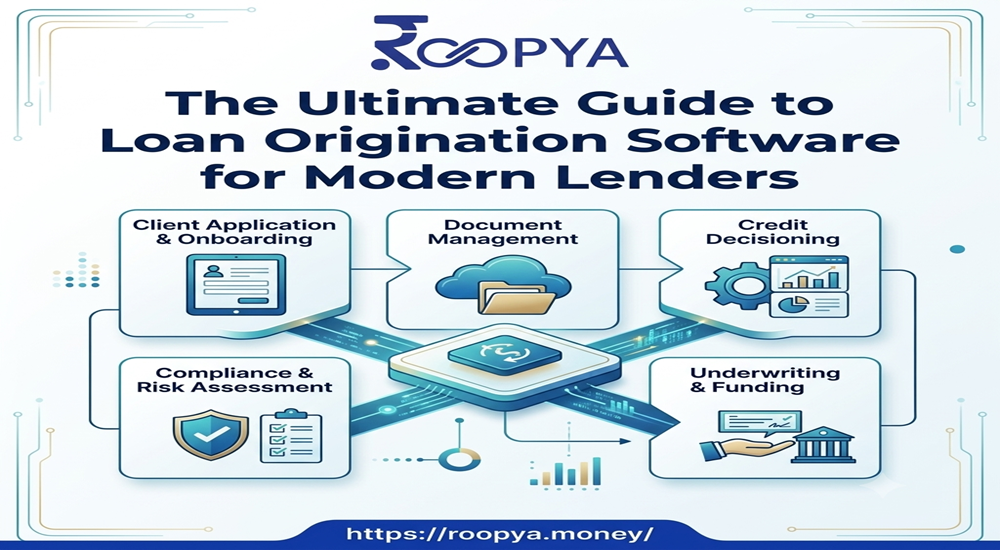
This guide covers everything you need to know about loan origination software: what it is, how it works, what features matter most, how to choose the right platform, and why Roopya has become the preferred choice for modern lenders across India.
1. What Is Loan Origination Software?
Loan origination software (LOS) is a digital platform that manages the complete journey of a loan — from the moment a borrower first applies, through credit assessment, document verification, credit decisioning, sanction, agreement execution, and disbursement. It is the operational backbone of a lending business, replacing manual, paper-driven processes with automated, data-driven workflows.
The term ‘loan origination’ refers specifically to the process of creating a new loan — as opposed to loan servicing, which involves managing an existing loan portfolio. A loan origination system handles everything that happens before the money moves: collecting borrower data, verifying identity and income, assessing creditworthiness, generating an offer, obtaining signatures, and triggering disbursement.
In practice, a modern loan origination platform is not a single tool but an orchestration layer. It connects dozens of external data sources — credit bureaus, KYC providers, bank account aggregators, GST portals, employment databases — and routes information through configurable credit policies to deliver fast, consistent, and compliant lending decisions at scale.
Roopya’s loan origination software is built precisely for this purpose: a no-code, cloud-native platform that lets lenders go live with a fully digital origination workflow in as little as one day, without writing a single line of custom code.
2. Why Modern Lenders Cannot Afford to Skip LOS Modernisation
The Indian lending industry is at an inflection point. Digital lending disbursements have crossed ₹1.5 lakh crore annually and continue to grow at 25–30% year-on-year. The RBI’s Digital Lending Guidelines have made technology-led transparency and auditability mandatory, not optional. Meanwhile, fintech-first lenders are setting a new bar for borrower experience — approvals in minutes, disbursements in hours, zero paperwork.
Traditional lenders — NBFCs, cooperative banks, MFIs — that rely on manual origination processes face a compounding disadvantage. Each manual step adds processing time, cost, and risk. Human underwriters make inconsistent decisions. Data entry errors create compliance exposure. Physical document handling introduces fraud risk and delays. And as volumes grow, so do the teams required to process them.
Loan origination software solves all of these problems simultaneously. It compresses the origination timeline from days or weeks to minutes or hours. It reduces processing costs by 40–70%. It enforces credit policy consistently across every application. And it does all of this while generating the digital audit trails that regulators now require.
For lenders in India today, modernising loan origination is not a technology project — it is a business survival imperative.
3. The Loan Origination Lifecycle: A Stage-by-Stage Breakdown
Understanding loan origination software starts with understanding the lifecycle it manages. Each stage presents distinct challenges that good software addresses systematically.
Stage 1: Lead Capture and Application Intake
The origination journey begins when a prospective borrower expresses interest in a loan. Modern loan origination software captures leads from multiple channels simultaneously — direct digital applications via web or mobile, DSA or agent-led applications, embedded finance integrations via API, and even conversational AI interfaces via WhatsApp or SMS. Each channel can have its own branded journey, tailored application form, and channel-specific eligibility rules, all managed from a single backend platform.
At the application intake stage, smart form design matters enormously. Well-designed digital forms with real-time validation — checking PAN structure, Aadhaar format, IFSC codes, and pincode-level geography as the borrower types — reduce incomplete applications dramatically, lowering the support burden and improving funnel conversion rates.
Stage 2: Identity Verification and KYC
Regulatory KYC compliance is mandatory for every loan application. In a manual process, KYC can take days — physical document submission, in-branch verification, manual database checks. A modern loan origination system automates this entirely.
Roopya’s platform integrates natively with Aadhaar eKYC (OTP and biometric), NSDL PAN verification, Digilocker for document retrieval, and Video KYC (VKYC) for remote identity confirmation. The moment a borrower provides consent, KYC is triggered and completed in under two minutes — from any device, anywhere in India, without visiting a branch. The entire process is logged for regulatory audit purposes automatically.
Stage 3: Credit Bureau Checks and Score Retrieval
A credit bureau report is the foundation of any credit decision. Loan origination software automatically pulls bureau reports from one or more bureaus — CIBIL, Experian, CRIF, Equifax — the moment KYC consent is obtained. The reports are parsed, normalised, and fed directly into the credit decisioning engine. No manual data entry, no delay, no risk of the bureau data being misread or misrecorded.
For thin-file borrowers — those with limited or no bureau history — modern platforms like Roopya can supplement bureau data with alternative data sources: account aggregator (AA) data, GST returns, bank statement analysis, and utility payment history, creating a richer credit picture for underserved borrower segments.
Stage 4: Document Collection and AI-Powered Analysis
Income verification is the most document-intensive part of loan origination. Borrowers submit salary slips, bank statements, ITR filings, Form 16, GST returns, and business financials — a pile of documents that, in a manual process, each require hours of analyst time to review and extract data from.
AI-powered OCR and NLP within modern loan origination software eliminates this bottleneck. Roopya’s intelligent document processing extracts key data points from uploaded documents — net monthly income, employer name, business revenue, tax liability, banking transactions — with accuracy rates exceeding 99%. It also flags anomalies: salary slips that don’t match banking credits, bank statements with signs of manipulation, or financial documents with inconsistent data across sources. These are fraud signals that human reviewers routinely miss.
Stage 5: Automated Underwriting and Credit Decisioning
This is the heart of loan origination — the moment where all collected data is synthesised into a credit decision. In a manual process, this involves an underwriter reviewing the file, applying a credit policy from their memory or a policy document, and making a judgement call. The result is inconsistency, delay, and human bias.
Loan origination software replaces this with a Business Rule Engine (BRE) — a configurable, automated decisioning system that applies your credit policy to every application, every time, in seconds. A well-designed BRE can handle complex, multi-variable policies: income thresholds, bureau score cutoffs, employment type filters, geographic restrictions, product eligibility criteria, customer segment rules, and more.
Roopya’s no-code BRE allows credit and risk teams to configure, test, and deploy decisioning rules through an intuitive visual interface — without writing code. Credit policy changes that would previously require weeks of IT development can be made live in hours. The BRE also incorporates ML-based credit scoring models that learn from portfolio performance, continuously refining their predictions over time.
Stage 6: Loan Offer Generation and Borrower Communication
For approved applications, the loan origination platform generates a personalised loan offer — specifying the sanctioned amount, applicable interest rate, tenure, EMI schedule, and any conditions. The offer is delivered to the borrower instantly via the application interface, SMS, WhatsApp, or email. Borrowers can review and accept digitally, triggering the next stage of the process automatically without any human intervention.
Stage 7: Legal Documentation and eSign
Once a borrower accepts an offer, the loan agreement must be executed. In a manual process, this means printing agreements, couriering them for signature, receiving them back, and verifying signatures — a process that can take three to five business days and costs hundreds of rupees per loan in logistics.
Loan origination software integrates with eSign providers to enable instant, legally valid, paperless agreement execution. Roopya supports Aadhaar OTP-based eSign and Digilocker-based digital signatures — both fully valid under the Information Technology Act. Agreements are executed in minutes, from the borrower’s device, with a complete audit trail automatically generated.
Stage 8: Disbursement Trigger and Post-Sanction Workflow
The final stage of origination is disbursement initiation. The completed and signed loan file is handed off to the loan management system, which triggers the disbursement workflow — bank account validation via penny drop, NACH mandate registration, and fund transfer initiation. A well-integrated loan origination platform handles this handoff automatically, with the loan management system picking up exactly where origination leaves off.
4. Core Features of Best-in-Class Loan Origination Software
No-Code Configuration and Workflow Builder
The ability to configure origination workflows without writing code is the single most important feature of modern loan origination software. Credit policies change. New products are launched. New regulatory requirements emerge. A no-code platform gives business teams the ability to respond to these changes independently, without waiting for IT development cycles. Roopya’s visual workflow builder allows lenders to design, test, and deploy complex origination workflows — including multi-stage approvals, conditional routing, and exception handling — through a drag-and-drop interface.
300+ Pre-Built API Integrations
A loan origination system is only as powerful as its data ecosystem. Roopya comes pre-integrated with over 300 APIs including all four major credit bureaus, Aadhaar eKYC and VKYC providers, PAN verification, Digilocker, account aggregator (AA) platforms, GST data APIs, bank statement analysis services, eSign providers, payment gateways, NACH registration platforms, CERSAI, and major accounting and ERP systems. These integrations are plug-and-play — no custom development required, no additional integration costs.
Multi-Product and Multi-Lender Architecture
Modern lending businesses rarely operate a single product. A well-designed loan origination platform must support multiple product lines — personal loans, business loans, gold loans, home loans, microfinance — each with its own application journey, document requirements, credit policy, and decisioning rules. Roopya’s multi-product architecture supports 20+ pre-configured product journeys, with the ability to add new products without rebuilding the platform.
Real-Time Dashboard and Analytics
Visibility into the origination funnel is critical for lending operations. How many applications are in each stage? What is the approval rate by product, channel, or geography? Where is the highest drop-off in the funnel? What percentage of applications require manual review? Roopya’s real-time analytics dashboard answers all of these questions, with drill-down capability that lets operations teams diagnose and resolve bottlenecks in the origination pipeline.
Intelligent Fraud Detection
Loan fraud is a significant and growing problem in digital lending. Modern loan origination software incorporates multiple layers of fraud detection: AI-powered document authenticity checks, facial recognition matching against KYC photos, cross-referencing of declared income against banking data, duplicate application detection, device fingerprinting, and behavioural analytics. Roopya’s fraud detection capabilities flag suspicious applications for enhanced review before a credit decision is made — reducing fraud losses without creating unnecessary friction for genuine borrowers.
Maker-Checker and Role-Based Access Controls
For applications that require human review — complex cases, large ticket sizes, or exception approvals — loan origination software provides structured maker-checker workflows. Applications are routed to the appropriate reviewer based on configurable rules. Reviewers see exactly the data and recommendations they need. All actions are logged. Role-based access controls ensure that team members only see and act on applications appropriate to their authority level, maintaining compliance and preventing unauthorised access.
Embedded Finance and API-First Architecture
One of the most important emerging use cases for loan origination software is embedded finance — the ability for non-financial platforms to offer lending products to their users, powered by a backend lender’s origination infrastructure. Roopya’s API-first architecture makes this straightforward: partner platforms can embed loan application flows directly into their own user journeys via API, with Roopya handling all the orchestration, compliance, and decisioning on the backend.
5. Types of Lenders That Need Loan Origination Software
Non-Banking Financial Companies (NBFCs)
NBFCs are the primary users of loan origination software in India. Operating without the branch networks of banks, NBFCs depend heavily on digital origination to reach borrowers at scale. Whether a consumer lending NBFC offering personal loans, an MSME lender focused on business credit, or a microfinance company serving rural borrowers, the origination workflow is the operational core of the business. Roopya was built specifically for the NBFC context — RBI-compliant, India-specific, and designed to support the full range of NBFC product types and borrower segments.
Banks and Small Finance Banks (SFBs)
Banks increasingly use loan origination software for their retail and MSME lending divisions, where digital origination drives faster processing and lower cost-per-application. Small Finance Banks (SFBs) are particularly strong adopters, given their focus on underserved borrower segments who benefit most from frictionless digital journeys. Loan origination software helps banks reduce branch dependency, improve underwriting consistency, and generate the digital audit trails required for regulatory reporting.
Microfinance Institutions (MFIs)
MFIs present unique origination challenges: group lending models, joint liability group (JLG) workflows, rural connectivity constraints, and a borrower population that may have limited digital literacy. Modern loan origination software must accommodate these requirements — supporting group applications, offline data capture with sync capability, vernacular language interfaces, and simplified KYC workflows suitable for rural borrowers. Roopya’s MFI-specific product journeys are designed for exactly these constraints.
Fintech Lenders and Co-Lending Platforms
Fintech lenders are the fastest-growing segment of digital origination users. Born digital, these companies demand origination software that is API-first, infinitely configurable, and capable of supporting innovative credit models — alternative data underwriting, embedded finance origination, buy-now-pay-later workflows, and co-lending partnerships. Roopya’s open architecture and pay-as-you-use model make it the natural choice for fintech lenders who need enterprise-grade infrastructure without enterprise-level upfront investment.
6. Loan Origination Software vs. Loan Management Software: Understanding the Difference
This distinction causes significant confusion in the market, so it is worth addressing clearly.
Loan origination software (LOS) manages the process of creating new loans — from application through disbursement. It deals with the pre-disbursement lifecycle: who is applying, are they creditworthy, what offer should they receive, and how do we get money to them?
Loan management software (LMS) — also called a Loan Management System — manages existing loans after disbursement. It deals with the post-disbursement lifecycle: EMI collection, interest calculations, prepayments, defaults, restructuring, and portfolio analytics.
A complete lending technology stack requires both. Roopya provides both LOS and LMS as integrated, unified modules on the same platform — meaning borrower data captured at origination flows seamlessly into the loan management system without manual re-entry or data migration, and repayment performance data from the LMS feeds back into the BRE to continuously refine credit decisioning.
7. The ROI of Modern Loan Origination Software
Investing in loan origination software is not purely a technology decision — it is a financial one. The returns are measurable and significant.
- Processing Time Reduction: Manual origination takes 3–10 business days. Automated origination on Roopya takes 10–60 minutes for clean profiles. This compresses the cash deployment cycle dramatically.
- Cost per Application: Manual processing costs ₹800–2,000 per application when staff time, physical documentation, and courier costs are factored in. Automated processing reduces this to ₹150–400 per application.
- Conversion Rate Improvement: Faster decisions and friction-free journeys convert more applicants into borrowers. Lenders typically see 15–25% higher funnel conversion rates after implementing modern loan origination software.
- Fraud Loss Reduction: AI-powered fraud detection catches synthetic identity fraud, document manipulation, and duplicate applications that manual review misses. Fraud loss rates typically fall by 30–50% after implementation.
- Compliance Cost Reduction: Automated audit trails, digital consent management, and regulatory reporting eliminate hours of manual compliance work per application. Monthly compliance reporting that took days can be generated in minutes.
- Scalability: Processing 10x the volume with the same team is possible with automated origination — not with manual processes. This is the most important ROI driver for growing lenders.
8. How to Choose the Right Loan Origination Software: A Practical Checklist
- Time-to-live: Can you go live in days, or will implementation take 6–12 months? Ask for references from lenders who went live recently.
- No-code vs. low-code vs. custom: Can your business team configure workflows and credit policies, or does every change require a developer? True no-code is the gold standard.
- Integration ecosystem: How many integrations are pre-built? Are all four major credit bureaus supported? Is Account Aggregator integration available?
- Product flexibility: Can the platform support all your current product types, plus new ones you might add? Can one platform manage multiple lender entities?
- AI and analytics capabilities: Are document analysis, fraud detection, and credit scoring built in? What does the analytics dashboard look like?
- Compliance and regulatory readiness: Is the platform updated for current RBI guidelines? Are audit trails, consent management, and bureau reporting built in?
- Pricing model: Is there a large upfront licence fee, or can you start on a pay-as-you-use basis? Does pricing scale proportionally with volume?
- Support and SLA: What is the uptime guarantee? Is support available 24/7? What does implementation support look like?
9. Loan Origination Software in India: The Regulatory Context
India’s digital lending regulatory environment has evolved significantly since the RBI’s Digital Lending Guidelines issued in 2022. Key requirements that loan origination software must address include:
- Borrower consent: Explicit, informed consent must be obtained before pulling credit bureau data or personal information from third-party sources. LOS must log and store consent records digitally.
- Key Fact Statement (KFS): A standardised KFS must be provided to borrowers before loan agreement execution. LOS must generate and deliver the KFS automatically.
- Data localisation: All borrower data must be stored on servers located in India. Cloud-native Indian LOS platforms meet this requirement by default.
- Fair Practice Code (FPC): The full origination process must be documented and auditable. Digital audit trails generated automatically by LOS satisfy this requirement.
- Credit bureau reporting: New loans must be reported to credit bureaus within specified timelines. LOS with integrated bureau reporting automates this requirement.
Roopya’s platform is built with all of these requirements as standard features, ensuring that lenders using the platform are compliant from day one without additional customisation.
10. The Future of Loan Origination Software
The loan origination software landscape is evolving rapidly. Several trends will define the next generation of platforms:
Account Aggregator-Powered Underwriting
The Account Aggregator (AA) framework, enabled by the RBI, allows borrowers to share their financial data — bank statements, mutual fund holdings, insurance policies — directly with lenders through a consent-based API framework. This dramatically improves underwriting quality, particularly for self-employed and thin-file borrowers, and reduces the document collection burden significantly. Loan origination platforms with native AA integration will have a substantial advantage in the next three to five years.
AI-Generated Credit Narratives
The next frontier in credit decisioning is AI-generated credit narratives — natural language explanations of why a specific credit decision was made, pulling together bureau data, document analysis, banking behaviour, and policy parameters into a readable summary for human underwriters reviewing referred cases. This improves consistency, speeds up manual review, and creates explainable AI decisions that satisfy regulatory requirements.
Embedded Finance at Scale
As more non-financial platforms — e-commerce marketplaces, payroll platforms, gig economy apps, ERP systems — seek to embed lending into their user journeys, the demand for API-first loan origination software will grow exponentially. Lenders that can serve as embedded finance infrastructure providers — offering their origination, credit decisioning, and capital as a service to platform partners — will access entirely new distribution channels.
Vernacular and Voice-Driven Origination
India’s next 200 million borrowers do not read English and may not be comfortable with typed digital interfaces. Voice-driven and vernacular loan origination journeys — available in Hindi, Tamil, Bengali, Telugu, and other major Indian languages — will be essential for reaching underserved markets. Loan origination software that supports multilingual, multimodal interfaces will have a significant advantage in Tier 2, Tier 3, and rural lending.
11. Why Roopya Is the Best Loan Origination Software for Modern Indian Lenders
Roopya was designed from the ground up for the realities of lending in India — its regulatory requirements, its borrower demographics, its technology ecosystem, and its market dynamics. It is not a global platform adapted for the Indian market; it is an Indian platform built with Indian complexity as its starting point.
- 1-Day Go-Live: Pre-configured product journeys, plug-and-play integrations, and a no-code setup interface mean most lenders can begin processing live applications within 24 hours of onboarding.
- 300+ Pre-Integrated APIs: Every major bureau, KYC provider, eSign platform, account aggregator, payment gateway, and banking tool is already connected. No custom development required.
- Truly No-Code: Business users configure credit policies, workflows, and product parameters independently. No developer needed for policy changes, new product launches, or workflow modifications.
- Full LOS + LMS: Origination and loan management are unified on a single platform. Data flows seamlessly from pre-sanction to post-disbursement without manual handoffs.
- AI at Every Stage: Document analysis, fraud detection, credit scoring, and the self-learning BRE together create a decisioning engine that gets smarter with every application processed.
- Pay-As-You-Use Pricing: Zero upfront licence costs. You pay only for what you process. Pricing scales with your business — not ahead of it.
- RBI-Compliant by Design: Audit trails, consent management, KFS generation, bureau reporting, and data localisation are all built in as standard features.
- Proven at Scale: Trusted by IndiaKaLoan, QuickFinShop, Recapita, Findoc, EazyCredit, and dozens of other lenders who have collectively processed lakhs of applications through the platform.
Whether you are a newly licensed NBFC setting up your first loan origination process, or an established lender modernising a legacy system, Roopya provides the infrastructure to originate loans faster, cheaper, and more intelligently — with zero compromise on compliance or control.
Book a free demo at roopya.money and see how quickly you can go live.

