How to Choose the Right Loan Origination System for Your Lending Business

The lending industry has undergone a profound digital transformation over the past decade. Whether you are running a Non-Banking Financial Company (NBFC), a cooperative bank, a microfinance institution, or a full-scale digital lending startup, the backbone of your operations rests on one critical piece of technology: the Loan Origination System (LOS).
Choosing the wrong system can mean sluggish approval cycles, poor customer experiences, costly integrations, and regulatory headaches. Choosing the right one, however, can unlock unprecedented speed, accuracy, scalability, and profitability. At Roopya.money, we understand the complexity of this decision and have built our platform to address the real pain points of modern lenders.
This comprehensive guide walks you through everything you need to know — from understanding what a Loan Origination System is, to evaluating vendors, comparing features, and making a confident investment decision for your business.
Start Free Trial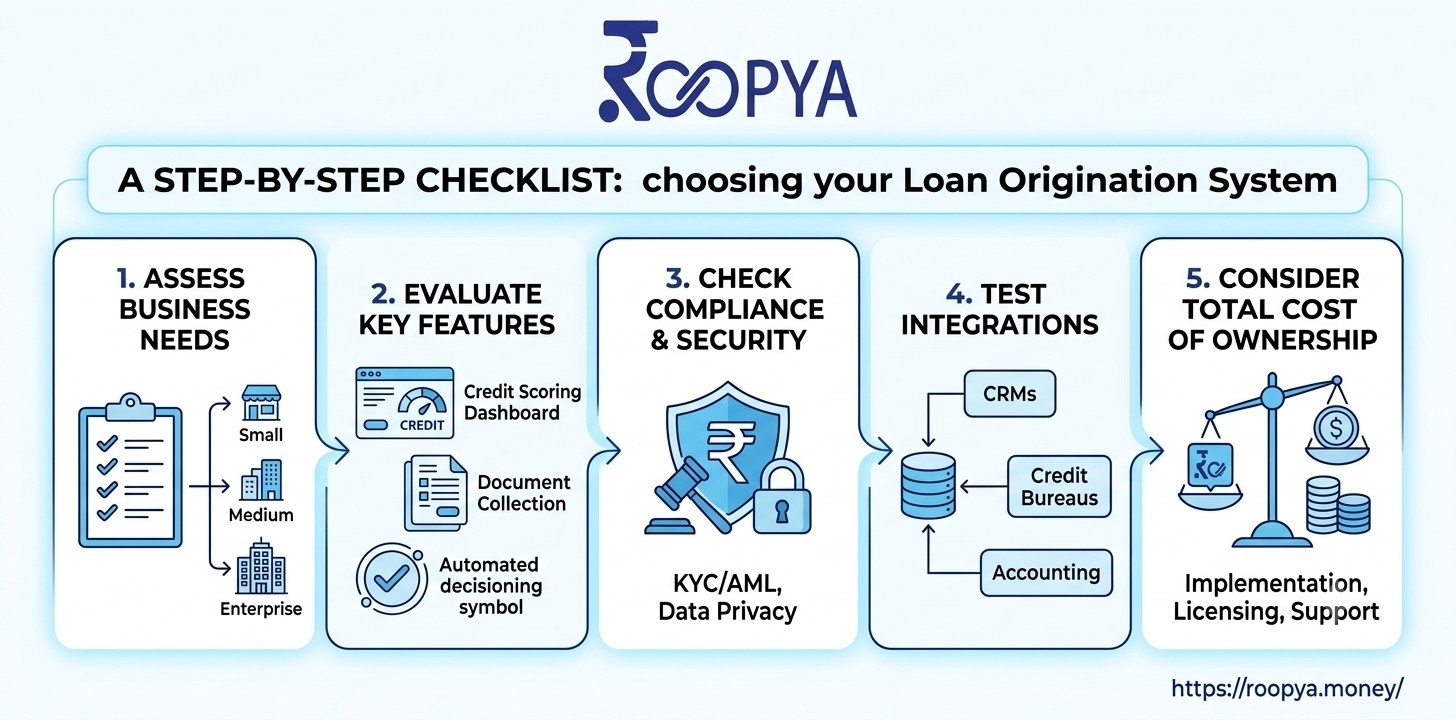
What Is a Loan Origination System (LOS)?
A Loan Origination System (LOS) is a software platform that automates and manages the end-to-end process of creating a loan — from the moment a borrower applies to the moment funds are disbursed. It is the digital engine that powers a lending institution’s ability to receive, evaluate, approve, and process loan applications at scale.
A robust LOS handles multiple critical workflows in an integrated manner:
- Application intake and document collection
- Identity verification and KYC/AML compliance
- Credit bureau pulls and CIBIL score evaluation
- Automated underwriting and risk scoring
- Loan structuring and offer generation
- Approval workflow and digital consent
- Disbursement instruction and post-sanction management
Without a capable LOS, lenders rely on manual processes — spreadsheets, physical documents, and fragmented software tools — that are slow, error-prone, and impossible to scale.
Why Choosing the Right LOS Matters
The LOS you choose will define how fast you can onboard customers, how accurately you assess credit risk, how efficiently your teams operate, and how compliant you remain with evolving regulations. Here is why the stakes are high:
1. Speed-to-Market
In a competitive lending market, every hour counts. A modern LOS with automation can reduce loan processing time from days to minutes. If your system requires manual touchpoints at every stage, you lose business to faster competitors.
2. Compliance and Regulatory Alignment
Indian lenders face strict guidelines from the Reserve Bank of India (RBI), UIDAI for Aadhaar-based eKYC, and credit information companies like CIBIL and CRIF. A non-compliant or poorly updated LOS exposes your institution to penalties, audits, and reputational risk.
3. Customer Experience
Borrowers today expect a seamless, mobile-first experience. Long turnaround times, repeated document requests, and lack of real-time status updates push borrowers away. The right LOS delivers a smooth digital journey that builds trust and repeat business.
4. Operational Efficiency
An integrated LOS eliminates duplication of effort, reduces manual errors, and allows your credit and operations teams to focus on judgment-intensive tasks rather than data entry. This directly improves your cost-per-loan metric.
5. Scalability
As your loan book grows from hundreds to thousands of applications per day, your system must scale accordingly. A cloud-native LOS built on modern architecture handles volume spikes effortlessly, while legacy systems crumble under pressure.
Key Features to Look For in a Loan Origination System
Not all LOS platforms are created equal. Here is a detailed breakdown of the must-have features every serious lender should evaluate:
1. Digital Application & Borrower Onboarding
The system should support mobile-responsive web forms, API-based integrations, and co-lending partner portals. It should allow borrowers to submit applications, upload documents, and e-sign agreements entirely online — without visiting a branch.
2. Automated KYC and Document Verification
Integration with Aadhaar eKYC, PAN verification, Digilocker, and video KYC (vKYC) is essential for regulatory compliance and fast onboarding. Look for systems that auto-verify documents using OCR and AI, reducing manual review time.
3. Credit Bureau Integration
Seamless API connectivity with CIBIL, Experian, Equifax, and CRIF High Mark is non-negotiable. The system should pull bureau data automatically during application processing and factor it into credit decisioning models.
4. Configurable Credit Decisioning Engine
A rule-based or AI-driven decisioning engine allows your credit team to set policies, scorecards, and risk thresholds without engineering intervention. This enables rapid policy changes in response to portfolio performance or market conditions.
5. Workflow Automation and Task Management
Every step in the origination pipeline — from application review to underwriting to legal checks — should be assignable, trackable, and auditable. SLA alerts, automated escalations, and role-based access ensure nothing falls through the cracks.
6. Multi-Product and Multi-Segment Support
Whether you offer personal loans, business loans, MSME lending, gold loans, vehicle finance, or microfinance, your LOS should support diverse product configurations on a single platform. Switching systems every time you launch a new product is expensive.
7. Integration Ecosystem
A modern LOS must integrate with a broad ecosystem: accounting software, core banking systems (CBS), collection management tools, NACH and payment gateways, GST portals, and third-party analytics platforms. An open API architecture makes this feasible.
8. Reporting, Analytics & Dashboards
Real-time dashboards showing pipeline metrics, approval rates, TAT (turnaround time) analysis, and credit quality indicators are essential for business intelligence. Exportable reports simplify board presentations and RBI audit submissions.
9. Co-Lending and DSA Management
If you work with co-lending partners or a Direct Selling Agent (DSA) network, the LOS should support partner portals, split disbursement logic, and commission management — all within a secure, role-controlled environment.
10. Mobile Access for Field Officers
For lenders with field sales teams, a mobile-optimized interface allows officers to initiate applications, collect geo-tagged documents, and push updates in real time — even in low-bandwidth rural environments.
Types of Loan Origination Systems Available Today
1. On-Premise LOS
Installed on your own servers, these systems offer maximum data control but require significant IT infrastructure, in-house maintenance teams, and lengthy implementation timelines. They are typically chosen by large public sector banks.
2. Cloud-Based SaaS LOS
Hosted on the vendor’s cloud infrastructure, SaaS-based LOS platforms like Roopya.money offer faster deployment, automatic updates, lower upfront costs, and built-in security compliance. Ideal for NBFCs, fintechs, and growth-stage lenders.
3. Hybrid LOS
A combination of on-premise and cloud components, hybrid systems allow sensitive data to remain on local servers while leveraging cloud capabilities for processing and analytics. They offer flexibility but can be complex to manage.
4. Open-Source LOS
While free to use, open-source systems require significant customization effort, development resources, and are often lacking in compliance features required for regulated Indian lenders. They are generally not recommended for production environments.
A Step-by-Step Framework for Evaluating LOS Vendors
Use this structured approach when shortlisting and comparing Loan Origination System vendors:
Step 1 — Define Your Business Requirements
Before approaching vendors, document your loan products, average ticket sizes, monthly application volumes, geography, regulatory requirements, and integration needs. This clarity helps filter vendors who truly fit your use case.
Step 2 — Create a Feature Checklist
Use the feature list outlined above as your baseline. Weight each feature based on its criticality to your operations. For instance, if you are an MSME lender, GST data integration and cash flow analysis tools are more important than branch walk-in features.
Step 3 — Shortlist 3–5 Vendors
Research vendors active in the Indian lending technology space. Attend fintech conferences, check peer reviews on platforms like G2 and Capterra, and ask for referrals from your industry network. Narrow down to a manageable shortlist for demos.
Step 4 — Request Live Product Demos
A demo should be tailored to your loan product type, not a generic walkthrough. Ask vendors to demonstrate your specific workflows — from application intake to disbursement — using a realistic scenario. Pay attention to configurability and speed.
Step 5 — Evaluate Integration Capabilities
Request a technical integration document. Verify that the LOS supports REST APIs, webhooks, and sandbox environments. Test actual API calls with your IT team before committing to a contract.
Step 6 — Assess Implementation Timeline and Support
Ask vendors for implementation case studies with similar clients. Understand the average go-live timeline, onboarding methodology, training support, and post-launch SLA commitments for bug fixes and uptime guarantees.
Step 7 — Analyze Total Cost of Ownership (TCO)
Compare not just license or subscription fees, but also implementation costs, API call charges, customization fees, and annual maintenance. A low headline price can mask high hidden costs that inflate your TCO over a 3-year horizon.
Step 8 — Run a Proof of Concept (PoC)
Before signing a long-term contract, negotiate a paid or free PoC where you run actual loan applications through the system in a controlled environment. This surfaces real-world issues that demos never reveal.
Common Mistakes Lenders Make When Choosing a LOS
- Choosing on price alone without evaluating long-term scalability
- Ignoring integration complexity with existing CBS or ERP systems
- Underestimating the importance of ongoing vendor support and updates
- Not involving credit, operations, and IT teams in the evaluation
- Failing to verify RBI compliance features before signing contracts
- Selecting a system that cannot be configured without developer intervention
- Overlooking mobile access requirements for field officers
- Not conducting reference checks with the vendor’s existing clients
Why Roopya.money Is the Right LOS for Indian Lenders
Roopya.money is a purpose-built lending intelligence platform designed for the unique complexity of the Indian credit ecosystem. Here is what sets Roopya apart from generic loan software:
Built for Indian Regulatory Compliance
Roopya is designed ground-up to comply with RBI guidelines, integrates natively with Aadhaar eKYC, PAN verification, CIBIL, and CRIF — so you launch compliant without retrofitting compliance.
No-Code Workflow Configuration
Your credit operations team can configure loan products, underwriting rules, document checklists, and approval hierarchies without writing a single line of code — dramatically reducing time-to-market for new products.
AI-Powered Credit Intelligence
Roopya’s embedded analytics and AI scoring engines analyze bureau data, bank statements, GST filings, and alternative data signals to produce nuanced credit decisions — far beyond a simple CIBIL cutoff.
Seamless Ecosystem Integrations
With pre-built connectors for leading CBS platforms, payment gateways, accounting tools, and insurance partners, Roopya plugs into your existing stack without costly custom development.
Cloud-Native, Scalable Architecture
Built on AWS with auto-scaling capabilities, Roopya handles growth from 100 to 100,000 applications per month without performance degradation or additional infrastructure investment.
Co-Lending and DSA Ready
Roopya supports multi-partner co-lending configurations, DSA network management, and partner performance analytics — making it the ideal platform for lenders building ecosystem-driven growth.
Selecting the right Loan Origination System is one of the most consequential technology decisions a lending institution will make. The right LOS accelerates growth, reduces risk, ensures compliance, and creates the kind of borrower experience that builds lasting loyalty.
The market offers many options, but not all are built for the nuances of the Indian lending ecosystem — multi-bureau integrations, Aadhaar-based eKYC, RBI compliance, co-lending, and the diverse credit profiles of Indian borrowers.
Roopya.money was built specifically for this environment. Whether you are a bootstrapped NBFC processing 500 applications a month or a well-funded fintech targeting 50,000 applications, Roopya scales with your ambition.
Take the first step today. Visit https://roopya.money/ to request a personalized demo and see how the right Loan Origination System can transform your lending business.

