Top 5 Loan Management Software Companies in India (2026): The Definitive Guide for NBFCs, Banks & Fintech Lenders

India’s lending ecosystem is one of the most dynamic and rapidly evolving in the world. With over 10,000 registered NBFCs, hundreds of microfinance institutions, and an increasingly digital-first borrower base, the pressure on lenders to modernise their technology infrastructure has never been greater. At the heart of this modernisation drive is the Loan Management System (LMS) — the software platform that manages the entire lifecycle of a loan from origination and disbursement to repayment, collections, and closure.
Choosing the right loan management software is not a minor operational decision. It is a strategic choice that determines how fast you can launch new products, how efficiently you can serve borrowers, how accurately you can manage risk, and how confidently you can face regulatory scrutiny. The wrong choice can cost months of implementation time, millions in lost business, and enormous compliance risk. The right choice can give you a genuine and durable competitive advantage.
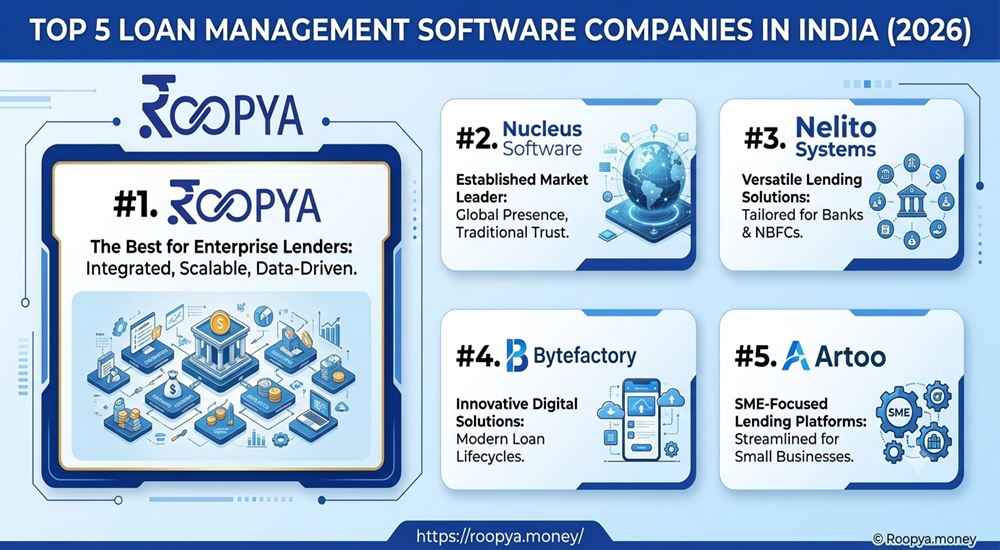
In this guide, we have researched and ranked the top 5 loan management software companies in India for 2026. Our evaluation covers the depth and quality of product features, ease of implementation, integration capabilities, AI and automation maturity, compliance readiness, pricing model, and — critically — how well each platform is designed for the specific realities of the Indian lending market.
Start Free Trial
Whether you are a newly licensed NBFC looking to launch your first product, a mid-sized MFI scaling into new districts, or an established bank modernising your retail lending stack, this guide will help you make an informed, confident decision.
What Is Loan Management Software and Why Does It Matter?
Before we rank the top companies, it is worth establishing precisely what loan management software does — because the term covers a wide range of capabilities, and not all platforms deliver the same depth of functionality.
A Loan Management System (LMS), also referred to as a Loan Management Software or Loan Origination System (LOS), is a technology platform that automates and manages the complete lifecycle of a lending product. This includes:
- Loan Origination: Digital application capture, KYC verification, credit bureau integration, document collection and AI-based analysis, and automated credit decisioning.
- Loan Sanctioning and Documentation: Offer letter generation, digital agreement execution, eSign integration, and disbursement authorisation workflows.
- Loan Disbursement: Integration with banking APIs and payment gateways to automate fund transfer to borrower accounts.
- Repayment and Collections Management: EMI scheduling, automated payment reminders via SMS and WhatsApp, NACH/e-mandate integration, overdue tracking, and collections workflow management.
- Portfolio Monitoring and Reporting: Real-time dashboards, NPA tracking, regulatory reporting, credit bureau reporting, and audit trail management.
- Compliance and Regulatory Functions: RBI reporting, CERSAI integration, Fair Practice Code adherence, and data localisation compliance.
A truly complete loan management software handles all of the above in a unified platform — eliminating the need for multiple point solutions and the data synchronisation problems they create. The best platforms go further, adding AI-driven insights, no-code configurability, and embedded finance APIs that allow lenders to operate entirely digitally and scale without proportional increases in headcount.
With that context established, here are the top 5 loan management software companies in India for 2026.
🏆 RANK #1
1. Roopya — Best Overall Loan Management Software for Indian Lenders
Website: https://roopya.money
Best For: NBFCs, MFIs, banks, fintech lenders — all sizes, all product types
Pricing: Pay-as-you-use | Zero upfront cost
Overview
Roopya is India’s most comprehensive no-code lending infrastructure platform, purpose-built for the Indian regulatory environment and borrower demographic. It is the only platform in this list that combines a complete Loan Origination System (LOS), Loan Management System (LMS), and embedded finance capabilities in a single, unified, no-code environment — enabling lenders to go live in a single day with zero custom development.
Roopya was developed to solve a specific and acute problem: most lending software available in India was either too rigid and expensive (legacy enterprise platforms), too narrow in scope (point solutions for specific functions), or not designed for the Indian regulatory context (global platforms adapted for India). Roopya fills this gap with a platform that is simultaneously enterprise-grade in capability, startup-friendly in pricing, and Indian-first in design.
Roopya is trusted by a growing roster of modern Indian lenders including IndiaKaLoan, QuickFinShop, Recapita, Findoc, and EazyCredit — lenders who chose Roopya specifically because it lets them operate, compete, and grow without the technology debt that burdens many of their peers.
Key Features
- 20+ Pre-Configured Loan Product Journeys: Personal loans, business loans, MSME credit, gold loans, home loans, LAP, auto loans, microfinance, and payday loans — all ready to deploy on Day 1.
- 300+ Pre-Integrated APIs: Credit bureaus (CIBIL, Experian, CRIF, Equifax), KYC providers (Aadhaar eKYC, PAN, VKYC, Digilocker), eSign platforms, payment gateways, accounting software, and banking APIs — all pre-built.
- No-Code Business Rule Engine (BRE): Configure and modify credit policies, eligibility rules, and decisioning logic visually — without writing a single line of code. The BRE self-learns from portfolio data, continuously improving decisioning accuracy.
- AI-Powered Document Processing: OCR and NLP-driven extraction and verification of bank statements, salary slips, ITR, GST returns, and identity documents — with 99%+ accuracy and automated fraud flag detection.
- Real-Time Credit Decisioning: From bureau data, device intelligence, bank statement analysis, and rule engine logic — instant approve/reject/manual-review decisions.
- Automated Repayment and Collections: NACH/e-mandate integration, automated EMI reminders via WhatsApp and SMS, overdue escalation workflows, and collections agent dashboards.
- Embedded Finance APIs: Partners can originate loans directly through Roopya’s APIs — enabling buy-now-pay-later, fintech partnerships, and co-lending arrangements without custom integration.
- Account Aggregator (AA) Ready: Full AA framework integration for consent-based financial data sharing, enabling better underwriting of thin-file and new-to-credit borrowers.
- RBI-Compliant by Design: Audit trails, consent management, CERSAI integration, Fair Practice Code adherence, and data localisation — continuously updated for the latest regulatory requirements.
- 1-Day Go-Live: No implementation project, no custom development, no long procurement cycle. Configure, connect, and launch in 24 hours.
Roopya’s Competitive Advantages
What sets Roopya apart from every other platform on this list is the combination of breadth and speed. Most enterprise lending platforms offer comparable feature depth, but they require months to implement and dedicated technical teams to configure and maintain. Roopya delivers the same feature depth with a go-live timeline measured in hours, not months — and a pricing model that charges nothing upfront.
The no-code architecture is particularly important. Roopya’s business rule engine and product configuration interface are designed to be operated by credit and product teams — not developers. When market conditions change and credit policy needs to be updated, a risk manager can make that change in Roopya in minutes. In a legacy platform, the same change might require a change request, a development sprint, testing, and deployment — a process that can take weeks.
Roopya’s AI capabilities are also meaningfully differentiated. Document OCR accuracy, fraud detection, and predictive credit scoring models are trained specifically on Indian lending data — making them significantly more accurate than generic global models.
Ideal For
- NBFCs at any stage — from newly licensed to rapidly scaling.
- MFIs expanding geographically or moving from manual to digital operations.
- Fintech lenders building digital-first lending products.
- Banks or HFCs looking to modernise specific lending verticals without replacing their entire core banking system.
- Embedded finance platforms and co-lending arrangements.
Roopya Verdict: The best loan management software in India for 2026. Unmatched combination of feature depth, go-live speed, AI capability, and pricing flexibility. Our top recommendation for any Indian lender.
🥈 RANK #2
2. Nucleus Software — Enterprise-Grade LMS for Large Banks
Best For: Large banks and established financial institutions with significant IT budgets
Pricing: Enterprise licence (significant upfront investment)
Overview
Nucleus Software is one of India’s oldest and most established lending technology companies, with over three decades of experience in the financial services software space. Their flagship product, FinnOne Neo, is a comprehensive loan management platform deployed by several large banks and financial institutions across India and internationally. Nucleus Software has deep domain expertise and an extensive track record in enterprise deployments.
The platform covers retail lending, corporate lending, and Islamic banking, and is known for its regulatory compliance capabilities and its ability to handle very high transaction volumes in large-bank environments.
Key Features
- Comprehensive loan lifecycle management from origination through closure.
- Support for retail, SME, and corporate lending products.
- Strong regulatory reporting and compliance frameworks built for large bank requirements.
- Multi-currency and multi-language support for international deployments.
- Integration with core banking systems (CBS) through established APIs.
- Analytics and portfolio management dashboards.
Limitations
- Long Implementation Timeline: Enterprise deployments typically require six to eighteen months of implementation, customisation, and testing before going live.
- High Upfront Cost: Enterprise licence fees and implementation costs make this platform inaccessible for most NBFCs, MFIs, and early-stage lenders.
- Limited No-Code Configurability: Most configuration and customisation requires technical expertise and vendor involvement — business teams cannot self-serve.
- Less AI-Native: AI and automation capabilities are less deeply integrated than in newer platforms like Roopya.
- Not Designed for Rapid Product Launches: The platform’s enterprise architecture prioritises stability and compliance over speed and agility.
Nucleus Verdict: A proven, reliable choice for large banks with established IT teams and multi-year implementation budgets. Less suitable for NBFCs, MFIs, or any lender prioritising speed-to-market or operational agility.
🥉 RANK #3
3. Nelito Systems — Solid LMS for Mid-Size NBFCs and MFIs
Best For: Mid-size NBFCs, housing finance companies, and cooperative lenders
Pricing: Licence-based with implementation fees
Overview
Nelito Systems is a Mumbai-based financial technology company that has been serving NBFCs, housing finance companies, MFIs, and cooperative banks in India for over two decades. Their FinCraftTM Loan Management System is widely deployed in the mid-market segment and is known for its broad product coverage and India-specific compliance capabilities.
Nelito has built a strong reputation for understanding the specific operational needs of Indian NBFCs — including rural lending workflows, branch-level operations, and RBI reporting requirements. Their platform is particularly well-regarded in the housing finance and microfinance segments.
Key Features
- Comprehensive loan lifecycle management for retail and microfinance lending.
- Housing loan specific workflows including property valuation and legal check integration.
- Branch network management and rural operations support.
- RBI and NHB regulatory reporting built in.
- Integration with major credit bureaus and KYC service providers.
- Mobile-based field officer application for agent-led origination.
Limitations
- Moderate Go-Live Timeline: Typical implementation takes three to six months, limiting agility for fast-moving lenders.
- Limited AI Integration: The platform is functional but does not offer the depth of AI-powered automation available in newer platforms.
- UI and UX Constraints: The interface is functional but dated compared to newer platforms, which can affect adoption and training.
- Less Suitable for Digital-First Lenders: The platform is designed primarily for branch-based and agent-assisted operations rather than fully digital, app-first lending models.
- Constrained API Ecosystem: Fewer pre-built integrations than platforms like Roopya, requiring more custom development for fintech partnerships.
Nelito Verdict: A reliable, India-focused platform for mid-size NBFCs and MFIs with established branch networks. Less compelling for digital-first or rapidly scaling lenders.
4️⃣ RANK #4
4. Bytefactory (LoanNXT) — Modern LMS for Digital Lenders
Best For: Digital NBFCs and fintech lenders focused on personal and consumer lending
Pricing: SaaS subscription model
Overview
Bytefactory’s LoanNXT is a relatively newer entrant to the Indian loan management software market, positioned specifically for digital NBFCs and fintech lenders. The platform takes a cloud-native, API-first approach and is designed for lenders building fully digital lending journeys — particularly in consumer lending, personal finance, and BNPL segments.
LoanNXT has gained traction among newer digital lending companies that need a modern technology stack without the overhead of legacy enterprise systems. The platform’s clean UI and modular architecture have been well received in the startup lending community.
Key Features
- Cloud-native architecture with modern, mobile-responsive interfaces.
- API-first design enabling integration with third-party services and partner platforms.
- Digital-first origination workflows suited to consumer lending.
- Credit bureau integration and basic automated underwriting.
- Modular structure allowing lenders to deploy specific components as needed.
- SaaS pricing model with lower upfront commitment than legacy platforms.
Limitations
- Limited Product Breadth: Stronger for consumer and personal lending than for MSME, microfinance, or secured lending products.
- Smaller API Ecosystem: Fewer pre-built integrations than Roopya — more custom development may be required for specific bureau or KYC provider connections.
- Less Mature AI Stack: AI and automation capabilities are still developing compared to more established platforms.
- Smaller Track Record: As a newer platform, there is less evidence of large-scale, high-volume deployments than with Roopya or Nucleus.
- Limited Microfinance and Rural Support: The platform is not optimised for MFI-specific workflows like JLG lending, group collections, or rural field operations.
LoanNXT Verdict: A solid modern option for digital-first consumer lenders. May require supplementary tools or custom development for more complex product types or large-scale operations.
5️⃣ RANK #5
5. Artoo (Indifi Technologies) — MFI and Rural Lending Specialist
Best For: Microfinance institutions and rural NBFCs with field officer-led operations
Pricing: Licence-based with implementation fees
Overview
Artoo is a specialised loan management software platform built with a specific focus on the underserved segments of the Indian lending market — microfinance, rural MSME lending, and small-ticket secured loans. The platform is designed around the operational realities of lending in Tier 2, Tier 3, and rural geographies, including low-bandwidth connectivity, field officer-based operations, and the specific compliance requirements of MFI lending.
Artoo’s platform has been used by several microfinance institutions and community finance organisations in India, and it has a strong understanding of the JLG (Joint Liability Group) lending model and the associated collection and portfolio management workflows.
Key Features
- Optimised for low-bandwidth and offline-capable field operations.
- JLG (Joint Liability Group) lending workflows for microfinance institutions.
- Field officer mobile application with GPS-enabled client visits.
- Group loan management and centre meeting workflows.
- MFI-specific regulatory reporting for MFIN and RBI compliance.
- Basic credit bureau integration and KYC capabilities.
Limitations
- Narrow Product Focus: Optimised for microfinance and small-ticket lending — less suitable for large NBFCs offering diverse product portfolios.
- Limited Digital Origination: The platform’s strength is in assisted/field-led operations rather than digital self-service borrower journeys.
- Constrained Integration Ecosystem: Fewer API integrations than broader platforms.
- Less AI Capability: Limited automation and AI-driven underwriting compared to leading platforms.
- Scalability Constraints: May face limitations as an MFI scales to high digital volumes or seeks to diversify into non-microfinance products.
Artoo Verdict: A strong specialist choice for microfinance-focused lenders operating in rural India. Not recommended for NBFCs requiring broad product coverage or digital-first lending capabilities.
Head-to-Head Comparison: Top 5 Loan Management Software in India
The table below summarises the key dimensions across all five platforms to help you make a quick, structured comparison.
Platform | Go-Live Time | Pricing Model | AI Capability | Best For
Roopya | 1 Day | Pay-as-you-use | ★★★★★ | All lenders, all sizes
Nucleus Software | 6–18 months | Enterprise licence | ★★★ | Large banks only
Nelito Systems | 3–6 months | Licence + fees | ★★★ | Mid NBFCs, HFCs
LoanNXT | 4–8 weeks | SaaS subscription | ★★★ | Digital consumer lenders
Artoo | 2–4 months | Licence + fees | ★★ | MFIs, rural lenders
How to Choose the Right Loan Management Software for Your Business
The best loan management software for your business depends on your specific context — your product mix, borrower profile, team capabilities, regulatory obligations, and growth plans. Here are the most important factors to evaluate:
1. Speed of Implementation
If you are launching a new product, entering a new market, or replacing a legacy system urgently, implementation speed is paramount. Roopya’s 1-day go-live is unique in the market. Every other platform on this list requires weeks to months before you can process your first live application. Time is money in lending — every day without a functioning system is a day of lost origination.
2. Product Coverage
Does the platform support all the loan products you offer today — and the ones you plan to offer tomorrow? A platform that handles personal loans but not MSME credit or microfinance will force you to operate multiple systems as your portfolio evolves. Roopya’s 20+ pre-configured product journeys provide the broadest coverage on this list.
3. Integration Ecosystem
Modern lending requires integrations with credit bureaus, KYC providers, eSign platforms, payment gateways, accounting systems, and dozens of other services. The more pre-built integrations your platform offers, the less custom development you need. Roopya’s 300+ pre-integrated APIs set the benchmark in this dimension.
4. AI and Automation Maturity
AI is not a nice-to-have in modern lending — it is a core competency. Document processing accuracy, fraud detection, and credit scoring quality all directly impact your portfolio quality and operational efficiency. Evaluate the depth and India-specificity of each platform’s AI capabilities carefully.
5. No-Code Configurability
How much control do your business teams have over platform configuration? A truly no-code platform lets credit, product, and operations teams configure rules, workflows, and products independently — without raising development tickets. This is one of Roopya’s most important differentiators.
6. Pricing Model and Total Cost of Ownership
Enterprise licence models with high upfront costs and long implementation projects significantly increase the risk and total cost of a platform investment. Pay-as-you-use models like Roopya’s align the vendor’s incentives with your growth and eliminate upfront capital expenditure — particularly important for NBFCs and MFIs managing their balance sheets carefully.
7. Regulatory Compliance
India’s lending regulatory environment evolves rapidly. Your loan management software must be continuously updated to reflect the latest RBI guidelines, bureau reporting requirements, and compliance obligations. Evaluate each vendor’s track record and process for regulatory updates.
8. Scalability
Can the platform grow with you? A system that works for 500 applications a month may struggle at 50,000. Evaluate the infrastructure architecture — cloud-native, auto-scaling platforms like Roopya handle volume growth without additional infrastructure investment.
Why Roopya Remains the Top Choice for Indian Lenders in 2026
Having evaluated five of the most significant loan management software companies in India, the conclusion is clear: Roopya offers the most complete, fastest-to-deploy, and most cost-effective lending infrastructure platform available in the Indian market today.
It is the only platform that achieves the rare combination of enterprise-grade capability with startup-friendly accessibility — powered by a no-code architecture, 300+ pre-built integrations, advanced AI, and a pay-as-you-use pricing model that imposes no upfront capital burden.
For lenders who need to move fast, manage risk intelligently, serve borrowers digitally, and grow without technology constraints, Roopya is not just the top choice on this list — it is the platform that makes every other operational advantage possible.
To see how Roopya works for your specific lending business, request a free demo at roopya.money. The team can typically schedule a personalised walkthrough within 24 hours, and you can be live and processing applications the same day.

