12 Key Features of Modern Loan Origination Software (LOS)

The lending industry in India is undergoing a seismic shift. With the rise of digital-first NBFCs, fintech lenders, and modern banks competing on speed and convenience, the systems that power loan approvals can no longer afford to be manual, siloed, or slow.
Enter the Loan Origination Software (LOS) — the backbone of every modern lending operation. A well-built LOS is not just a form-filling tool. It is a full-stack intelligence layer that governs how a loan application enters your system, moves through underwriting, gets decisioned, and reaches disbursement — all while remaining compliant, fraud-resistant, and borrower-friendly.
But not all LOS platforms are created equal. Legacy systems are built around rigid workflows, on-premise infrastructure, and manual intervention at every stage. Modern loan origination software, by contrast, is cloud-native, API-first, no-code configurable, and AI-powered.
Start Free Trial
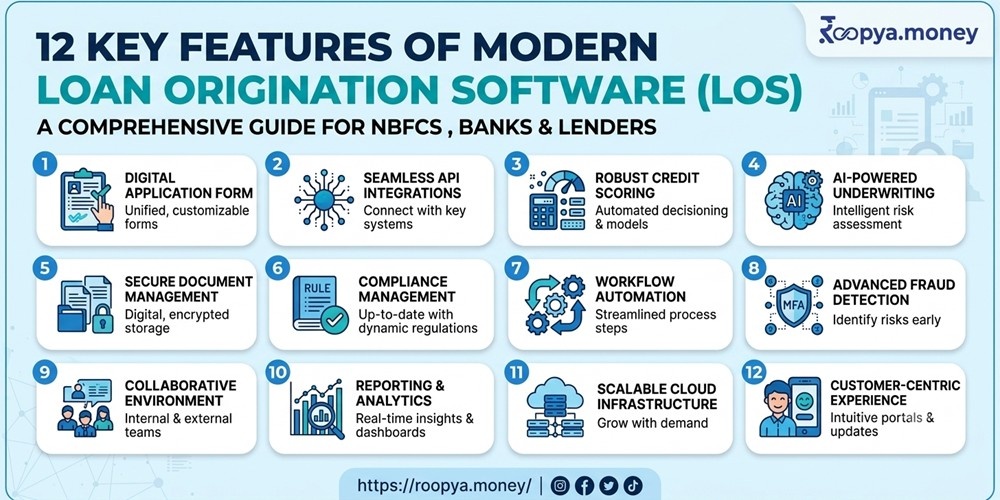
If you are evaluating a new LOS — or questioning whether your existing one still serves your growth — understanding the key features to look for is essential. In this guide, we break down .
12 key features of modern Loan Origination Software that every lender — NBFC, bank, or MFI — should demand in 2025 and beyond.
1. Digital Application & Onboarding
The borrower’s journey starts the moment they decide to apply. Modern LOS platforms eliminate paper forms and branch visits entirely by providing a seamless digital application experience — accessible via web or mobile — that collects borrower data in a structured, guided, and secure manner.
A truly modern onboarding module supports multi-product loan journeys, dynamic form logic (so irrelevant fields are hidden automatically), and real-time field validation. It should allow co-applicant and guarantor onboarding as part of the same journey without requiring the borrower to restart.
For lenders like NBFCs and MFIs serving semi-urban or rural India, the onboarding module should also support vernacular language interfaces and low-bandwidth environments.
Roopya’s LOS platform, for example, offers 20+ pre-configured loan product journeys out of the box — meaning lenders can go live with digital onboarding within a single day, with zero code required.
2. KYC & Document Verification (with AI-Powered OCR)
Collecting identity documents is one thing. Verifying them instantly and accurately is another. A key feature of any modern LOS is automated KYC and document verification — powered by Optical Character Recognition (OCR) and Artificial Intelligence.
This means the system can:
- Extract data from Aadhaar, PAN, passport, voter ID, and driving licence automatically
- Validate document authenticity using liveness detection and forgery checks
- Match extracted data against bureau or government databases in real time
- Flag discrepancies and trigger manual review workflows where needed
This eliminates a step that traditionally took 24–72 hours and reduces it to seconds. It also minimises human error in data entry and ensures a standardised verification process across every application.
Modern LOS platforms achieve 99%+ accuracy in document extraction, which directly reduces re-work, improves customer experience, and accelerates disbursement timelines.
3. Bureau Integration & Credit Scoring
The foundation of any credit decision is the borrower’s credit profile. Modern loan origination systems integrate directly with credit bureaus such as CIBIL, Equifax, Experian, and CRIF High Mark to pull credit reports in real time during the application journey.
But bureau data is just one layer. Advanced LOS platforms augment traditional bureau scores with:
- Alternative data sources — utility payment history, GST returns, bank statement analysis, UPI transaction patterns
- Application scorecards — statistical models built on the lender’s own historical data
- Behavioural scoring — based on how the applicant fills the form, device metadata, and session data
This multi-dimensional credit assessment gives lenders a far more accurate picture of creditworthiness than a single bureau pull — especially critical in India where a large segment of the population is thin-file or new-to-credit (NTC).
Roopya’s platform supports 300+ pre-integrated APIs, including all major credit bureaus, bank statement analysers, and alternative data providers — ensuring lenders can configure a rich credit decisioning stack without any custom integration effort.
4. No-Code Business Rule Engine (BRE)
Credit policy is the heart of a lender’s risk strategy. But in legacy systems, embedding credit rules into the software requires weeks of development time — and every policy change means another development cycle.
A No-Code Business Rule Engine (BRE) changes this entirely. It allows credit managers, risk officers, and business heads to define, modify, and deploy credit rules through a visual, drag-and-drop interface — without writing a single line of code.
Key capabilities of a modern BRE include:
- Rule chaining — chain multiple conditions to trigger complex decisioning logic
- Scorecard-based routing — route applications to different workflows based on score bands
- Policy versioning — maintain a history of rule changes with rollback capability
- Simulation mode — test a new rule on historical data before going live
This agility is a significant competitive advantage. When the RBI issues a new regulatory guideline, or when a lender wants to launch a new loan product targeting a new segment, the BRE allows rapid response without depending on engineering teams.
5. Automated Underwriting & Credit Decisioning
Manual underwriting is the single biggest bottleneck in most lending operations. It is slow, inconsistent, expensive, and difficult to scale. Modern LOS platforms replace — or substantially augment — manual underwriting with automated credit decisioning.
Automated underwriting in a modern LOS works by:
- Aggregating all data collected during onboarding (KYC, bureau scores, bank statements, income documents, alternative data)
- Running this data through the configured Business Rule Engine and scorecard models
- Producing a decision — Approve, Decline, or Refer — with a decision rationale report
- Routing referred cases to the right human underwriter with all context pre-populated
This means lenders can process high loan volumes with a fraction of the underwriting headcount, while maintaining decision consistency. AI-powered systems go a step further — learning from historical approval/rejection outcomes to continuously improve decision accuracy.
Roopya’s platform enables real-time decisioning that reduces loan approval timelines from days to milliseconds for fully automated cases.
6. Fraud Detection & Risk Management
Loan fraud is a growing challenge — and modern LOS platforms come with built-in, AI-powered fraud detection modules that operate across multiple layers of the application journey.
These include:
- Identity fraud detection — cross-checking applicant identity against known fraud databases and detecting synthetic identities
- Document tampering detection — using computer vision to identify edited or forged documents
- Device fingerprinting — flagging the same device being used for multiple applications under different identities
- Network analysis — detecting ring fraud by mapping relationships between applicants, guarantors, and references
- Behavioural biometrics — identifying anomalies in how an applicant interacts with the application form
A robust LOS does not treat fraud detection as an afterthought — it is embedded into every stage of the origination workflow. Lenders on advanced platforms report up to 80% reduction in fraudulent applications reaching disbursement.
7. Configurable Loan Product Framework
Every lender has a unique product portfolio — personal loans, business loans, gold loans, home loans, BNPL, microfinance, and more. Each of these products has different eligibility criteria, documentation requirements, tenure options, repayment structures, and pricing logic.
A modern LOS supports a configurable loan product framework that allows lenders to:
- Define and launch new loan products without code
- Set product-specific eligibility rules, document checklists, and workflow steps
- Configure interest rate structures — flat, reducing balance, step-up/step-down
- Support secured and unsecured products within the same platform
- Launch co-lending or partnership-based products with distinct workflows
This configurability allows a single LOS platform to power an entire product catalogue without needing multiple systems or custom builds for each product.
8. Seamless API Integration (Open Architecture)
Modern lending ecosystems are deeply interconnected. A lender’s LOS needs to talk to dozens of external systems — payment gateways, core banking systems, CRMs, accounting software, GST APIs, e-sign providers, e-NACH platforms, and more.
An open API architecture — built on REST standards — is therefore a non-negotiable feature of any modern LOS. It allows lenders to:
- Plug in new data providers and service vendors without rebuilding core workflows
- Push loan data to their Core Banking System (CBS) automatically at the point of sanction
- Trigger e-sign workflows directly from within the loan journey
- Connect with collection systems post-disbursement for seamless lifecycle handoff
- Build custom internal tools and dashboards on top of the LOS data layer
Roopya’s platform is built on open API architecture with 300+ pre-integrated APIs, reducing integration effort from months to hours and giving lenders the flexibility to evolve their tech stack over time.
9. Digital Loan Agreement & e-Sign
Once a loan is approved, the next step is loan agreement execution. In traditional lending, this involves printing documents, courier, physical signatures, and back-and-forth between branch and borrower — adding 3–7 days to the process.
Modern LOS platforms support fully digital loan agreement generation and e-Sign — compliant with India’s IT Act and the Aadhaar e-Sign framework — that reduces agreement execution to minutes.
The system:
- Auto-generates the loan agreement using the approved terms, borrower data, and lender templates
- Sends the agreement to the borrower’s registered mobile/email for e-Sign via OTP-based Aadhaar authentication or DSC
- Records the signed agreement in the loan record with an audit trail
- Initiates e-NACH mandate registration in the same workflow for automatic EMI collection
This single capability can cut disbursement TAT by multiple days and significantly improve borrower experience.
10. Multi-Channel Loan Sourcing & DSA Management
Loans don’t always originate from a single channel. Lenders typically receive applications from direct digital channels (website, app), Direct Selling Agents (DSAs), branch staff, connectors, and co-lending partners.
A modern LOS provides a unified multi-channel sourcing framework that:
- Assigns unique source codes to every lead channel for attribution tracking
- Provides DSA-specific portals where agents can submit and track applications on behalf of borrowers
- Manages DSA onboarding, KYC, and commission disbursement within the same system
- Gives branch-based or field officers a tailored view of their sourced cases
- Tracks conversion rates, approval rates, and performance metrics by channel and agent
This visibility is critical for lenders scaling through an intermediary-driven distribution model — especially in Tier 2 and Tier 3 markets.
11. Regulatory Compliance & Audit Trail
The Reserve Bank of India (RBI) has significantly increased regulatory scrutiny on NBFCs, MFIs, and digital lenders in recent years — covering Fair Practice Codes, digital lending guidelines, KYC norms, and data localisation requirements.
A modern LOS must therefore be compliance-first by design. Key compliance features include:
- Automated generation of Key Fact Statements (KFS) for every loan sanction
- Cooling-off period enforcement built into the disbursement workflow
- All borrower communications (SMS, email, in-app) logged with timestamps for audit
- Complete decision audit trail — every rule that fired, every bureau pull, every human intervention recorded
- Data residency on Indian servers, compliant with RBI’s data localisation mandate
- Role-based access control (RBAC) to ensure only authorised personnel can view or modify sensitive data
Platforms like Roopya are continuously updated to stay aligned with evolving RBI guidelines, removing the compliance burden from lenders’ internal teams.
12. Real-Time Analytics & Reporting Dashboard
You cannot manage what you cannot measure. A modern LOS includes a powerful analytics and reporting layer that gives leadership, risk teams, and operations managers real-time visibility into the loan origination funnel.
Key capabilities include:
- Funnel analytics — track drop-offs at every stage of the application journey
- Approval rate dashboards — segment by product, geography, channel, and credit score band
- TAT monitoring — identify bottlenecks in underwriting or operations causing delays
- Regulatory reports — auto-generate RBI-mandated reports (e.g., SMA reports, NPA reports) without manual compilation
- Custom dashboards — allow different teams to configure their own views and KPIs
- Scheduled reports — automatically email reports to stakeholders at defined intervals
AI-enhanced analytics platforms go further — using natural language queries (“What is my approval rate for business loans in Maharashtra this quarter?”) and auto-generating narrative insights from complex data sets.
Why These 12 Features Matter for Indian Lenders
The Indian digital lending market is projected to reach $1.3 trillion by 2030. The lenders who will capture this opportunity are not those with the most branch networks or the cheapest cost of funds — they are the ones with the most intelligent, agile, and scalable technology infrastructure.
A modern LOS that combines all 12 features listed above enables lenders to:
- Reduce TAT from days to hours — or even minutes for fully automated products
- Scale loan volumes without proportional increases in headcount
- Improve credit quality through better data, smarter models, and faster fraud detection
- Launch new products in days rather than months
- Stay compliant without dedicating entire teams to regulatory updates
The technology gap between best-in-class and average lenders has never been wider. The right LOS is not a cost centre — it is a strategic growth engine.
How Roopya Delivers All 12 Features in One Platform
Roopya is a next-generation digital lending platform purpose-built for modern Indian lenders — NBFCs, banks, MFIs, and fintech companies. It is a unified, no-code, cloud-native lending infrastructure that covers the entire lending lifecycle from origination to collections.
Here is how Roopya addresses each of the 12 features:
| Feature | Roopya Capability |
|---|---|
| Digital Onboarding | 20+ pre-configured loan journeys, 1-day go-live |
| AI KYC & OCR | 99%+ accuracy document extraction and verification |
| Bureau Integration | 300+ pre-integrated APIs including all major bureaus |
| No-Code BRE | Visual rule builder, version control, simulation |
| Automated Underwriting | Real-time AI decisioning, scorecard-based routing |
| Fraud Detection | AI-powered multi-layer fraud prevention |
| Loan Product Config | Configurable product framework, no code |
| Open API Architecture | REST APIs, seamless CBS and third-party integration |
| e-Sign & e-NACH | Aadhaar e-Sign + e-NACH mandate in one workflow |
| Multi-Channel Sourcing | DSA portal, branch interface, partner management |
| Compliance & Audit | RBI-aligned, KFS auto-generation, full audit trail |
| Analytics & Reporting | Custom dashboards, AI insights, scheduled reports |
With zero upfront cost, pay-as-you-use pricing, and the ability to go live in just 1 day, Roopya eliminates the traditional barriers of time and cost that have held lenders back from modernising their technology stack.
Choosing the right Loan Origination Software is one of the most consequential technology decisions a lender can make. The wrong system creates bottlenecks that slow growth, increase costs, and frustrate borrowers. The right system becomes a competitive moat — accelerating approvals, reducing risk, and enabling lenders to serve more borrowers, better.
The 12 features outlined in this guide — from AI-powered document verification and no-code BRE to open API architecture and real-time analytics — are the hallmarks of a modern, enterprise-grade LOS built for the demands of today’s lending market.
If you are evaluating an LOS upgrade or building a new lending stack from scratch, Roopya offers a platform that delivers all 12 of these features in a single, integrated, no-code environment — purpose-built for the Indian lending ecosystem.

