Compare Loan Management Software and Core Banking Software

The banking and financial services industry is rapidly embracing digital transformation. Banks, NBFCs, fintech companies, cooperative societies, microfinance institutions, and digital lenders are investing in technology platforms that improve efficiency, reduce operational costs, and deliver better customer experiences.
Among the most discussed technologies are Loan Management Software (LMS) and Core Banking Software (CBS). Although these systems often work together, they serve very different purposes.
Many organizations mistakenly assume they are interchangeable. In reality, choosing the wrong platform can lead to operational inefficiencies, higher costs, and slower business growth.
Start Free Trial
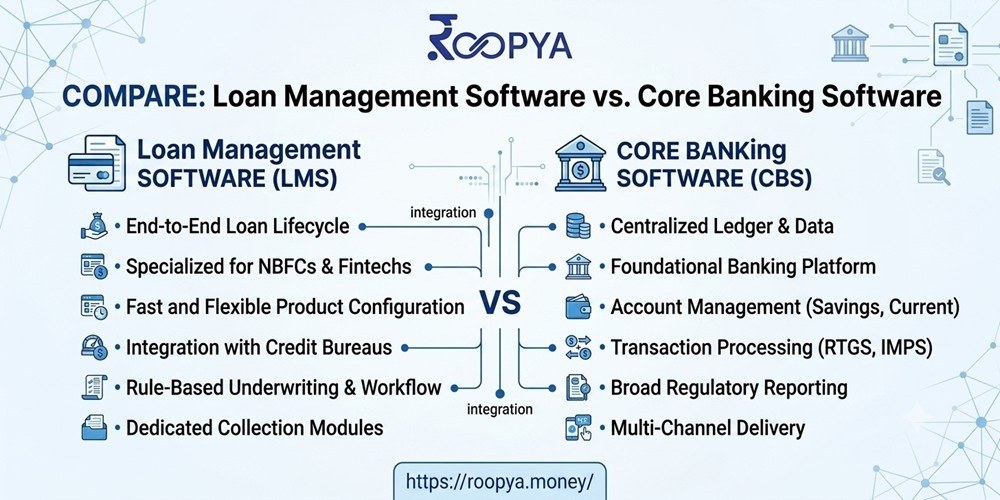
If your organization focuses primarily on lending, understanding the difference between these two technologies is critical.
Platforms like Roopya provide advanced cloud-based loan origination and loan management capabilities specifically designed for modern lenders, NBFCs, fintech companies, and financial institutions in India, offering automated workflows, AI-driven underwriting, digital onboarding, and integrated loan lifecycle management.
What is Loan Management Software?
Loan Management Software (LMS) is a specialized platform that manages loans after origination and throughout their lifecycle.
It helps financial institutions automate:
- Loan servicing
- EMI calculations
- Payment tracking
- Interest computation
- Collection management
- Customer communication
- Penalty calculations
- Foreclosure processing
- Loan restructuring
- Portfolio reporting
Instead of maintaining spreadsheets and manual records, lenders can manage thousands or even millions of loans from a centralized dashboard.
Modern systems also integrate with:
- Payment gateways
- Credit bureaus
- KYC providers
- Accounting software
- Collection agencies
- Analytics platforms
- CRM systems
What is Core Banking Software?
Core Banking Software is the central technology infrastructure used by banks to manage all banking operations.
It powers:
- Savings accounts
- Current accounts
- Fixed deposits
- Cash management
- Fund transfers
- Branch operations
- Treasury management
- Customer information
- Regulatory reporting
- General ledger
Core banking enables customers to access banking services from any branch or digital channel.
It forms the backbone of traditional commercial banking operations.
Why the Confusion Exists
Many banks have loan modules inside their core banking platforms.
However, those modules often provide only basic functionality.
Modern lenders require:
- Digital onboarding
- AI underwriting
- Automated workflows
- OCR document verification
- Rule engines
- API integrations
- Instant approvals
- Mobile applications
These capabilities are usually provided by dedicated loan origination and loan management platforms rather than traditional core banking systems.
Loan Management Software vs Core Banking Software
| Feature | Loan Management Software | Core Banking Software |
|---|---|---|
| Primary Purpose | Manage loans | Manage complete banking operations |
| Customer Accounts | Limited | Full banking accounts |
| Loan Lifecycle | Comprehensive | Basic to moderate |
| EMI Tracking | Advanced | Available but limited |
| Collections | Built-in | Often external |
| Digital Lending | Excellent | Usually limited |
| Credit Decisioning | Advanced | Basic |
| Rule Engine | Yes | Limited |
| AI Automation | Common | Less common |
| Loan Servicing | Core functionality | Secondary |
| Banking Operations | No | Yes |
| Deposit Management | No | Yes |
| Payments | Integrated | Native |
| Treasury | No | Yes |
| Branch Operations | No | Yes |
Architecture Comparison
Loan Management Software
Typical modules include:
- Customer onboarding
- Loan origination
- Credit assessment
- Underwriting
- Loan approval
- Documentation
- Disbursement
- Repayment management
- Collections
- Portfolio analytics
Core Banking Software
Usually includes:
- Customer information file
- CASA management
- Deposits
- Payments
- General ledger
- Treasury
- Trade finance
- Branch management
- Regulatory reporting
- Risk management
Which Organizations Need Loan Management Software?
Loan Management Software is ideal for:
- NBFCs
- Digital lenders
- Fintech companies
- Gold loan providers
- Vehicle finance companies
- Microfinance institutions
- MSME lenders
- Consumer finance companies
- Education loan providers
- Housing finance companies
Which Organizations Need Core Banking Software?
Core Banking Software is essential for:
- Commercial banks
- Cooperative banks
- Regional rural banks
- Small finance banks
- Universal banks
- Foreign banks
- Payment banks
- Full-service banking institutions
Benefits of Loan Management Software
1. Faster Loan Processing
Automation reduces manual intervention and accelerates approvals.
2. Better Customer Experience
Borrowers can apply online, upload documents digitally, and track application status.
3. Lower Operational Costs
Automation minimizes paperwork and repetitive tasks.
4. Improved Compliance
Integrated KYC and audit trails help maintain regulatory compliance.
5. Better Portfolio Monitoring
Dashboards provide insights into repayments, defaults, NPAs, and portfolio performance.
6. Scalable Operations
Cloud platforms support business growth without significant infrastructure investment.
Benefits of Core Banking Software
Unified Banking Operations
All branches access centralized customer data.
Real-Time Banking
Transactions update instantly across channels.
Better Customer Service
Customers can bank from any branch or digital platform.
Regulatory Reporting
Banks can generate reports required by regulators efficiently.
Enterprise Security
Robust controls protect customer data and transactions.
Can Loan Management Software Replace Core Banking Software?
No.
Loan Management Software specializes in lending.
Core Banking Software manages overall banking functions.
A bank still requires core banking for deposit accounts, payments, treasury, and other banking services.
Can Core Banking Software Replace Loan Management Software?
Partially.
Some CBS platforms include lending modules.
However, they often lack:
- AI underwriting
- OCR automation
- Dynamic workflows
- Business rule engines
- Digital onboarding
- Instant approvals
- Embedded analytics
Modern lenders frequently integrate a dedicated lending platform with their existing CBS.
Integration Between LMS and CBS
Many institutions use both systems together.
Typical integration flow:
- Customer applies online
- LMS performs KYC
- Credit bureau checks run automatically
- Rule engine evaluates eligibility
- Underwriter approves
- CBS creates loan account
- Funds are disbursed
- LMS manages repayments
- CBS updates financial records
Cloud-Based Lending is the Future
Cloud-native lending platforms provide:
- Lower infrastructure costs
- Automatic updates
- High availability
- API-first architecture
- Better scalability
- Faster implementation
Modern lending platforms such as Roopyya emphasize cloud deployment and automation for digital-first lenders.
AI in Modern Loan Management
Artificial intelligence enables:
- Fraud detection
- Alternative credit scoring
- Predictive default analysis
- Smart document verification
- OCR extraction
- Risk assessment
- Automated underwriting
These technologies reduce turnaround time while improving credit quality.
Security Considerations
Financial software should include:
- Data encryption
- Multi-factor authentication
- Audit logs
- Role-based access
- Secure APIs
- Disaster recovery
- Backup management
- Compliance controls
Industries Benefiting from Loan Management Software
- NBFCs
- Fintech startups
- Cooperative credit societies
- Gold loan companies
- Vehicle finance businesses
- Microfinance organizations
- Consumer durable finance providers
- Business lenders
- Personal loan providers
- Agricultural lenders
Key Features to Look For
When evaluating Loan Management Software, prioritize:
- Loan Origination System (LOS)
- Loan Management System (LMS)
- AI underwriting
- Rule engine
- Workflow automation
- API integrations
- OCR
- eKYC
- Credit bureau integration
- Analytics dashboard
- Mobile accessibility
- Cloud deployment
- Multi-product support
- Collections management
- Document management
Cost Comparison
| Area | Loan Management Software | Core Banking Software |
|---|---|---|
| Initial Cost | Medium | High |
| Implementation | Weeks | Months |
| Maintenance | Lower | Higher |
| Customization | Easier | Complex |
| Scalability | High | High |
| Cloud Support | Common | Increasing |
| Best For | Lenders | Banks |
Why NBFCs Prefer Dedicated Loan Management Platforms
NBFCs often focus exclusively on lending.
Instead of investing in enterprise-scale banking infrastructure, they benefit from platforms built specifically for:
- Loan origination
- Credit underwriting
- Repayment tracking
- Collections
- Portfolio management
- Compliance
- Customer servicing
Roopya positions its platform as an end-to-end loan origination and loan management solution for Indian NBFCs, fintechs, banks, and MFIs with configurable workflows and digital lending capabilities.
Loan Management Software and Core Banking Software serve complementary but distinct roles.
If your business primarily lends money and aims to automate the entire credit lifecycle, a dedicated Loan Management Software platform is typically the more suitable choice.
If you operate a full-service bank handling deposits, payments, branch operations, treasury, and lending, Core Banking Software remains indispensable.
Many modern financial institutions achieve the best results by integrating a robust loan management platform with their core banking infrastructure, creating a seamless digital lending ecosystem that improves efficiency, reduces costs, and enhances customer satisfaction.

