Switch to Roopya for AI-Powered Loan Management: The Smarter Way to Lend in India

Every year, thousands of NBFCs, banks, and microfinance institutions across India lose business not because they lack capital or customers — but because the software running their lending operations is holding them back. Outdated loan management systems generate errors, delay disbursements, frustrate borrowers, and leave compliance teams scrambling. Credit decisions that should take seconds take days. Collections that should be systematic are scattered. Reporting that should be instant requires hours of manual effort.
If this sounds familiar, it is time to consider a different path. Roopya is India’s next-generation, AI-powered loan management platform — built from the ground up for modern lenders who refuse to be constrained by legacy technology. Switch to Roopya means getting out of the cycle of workarounds, patch-fixes, and manual interventions, and stepping into a lending operation that runs faster, smarter, and at lower cost.
Start Free Trial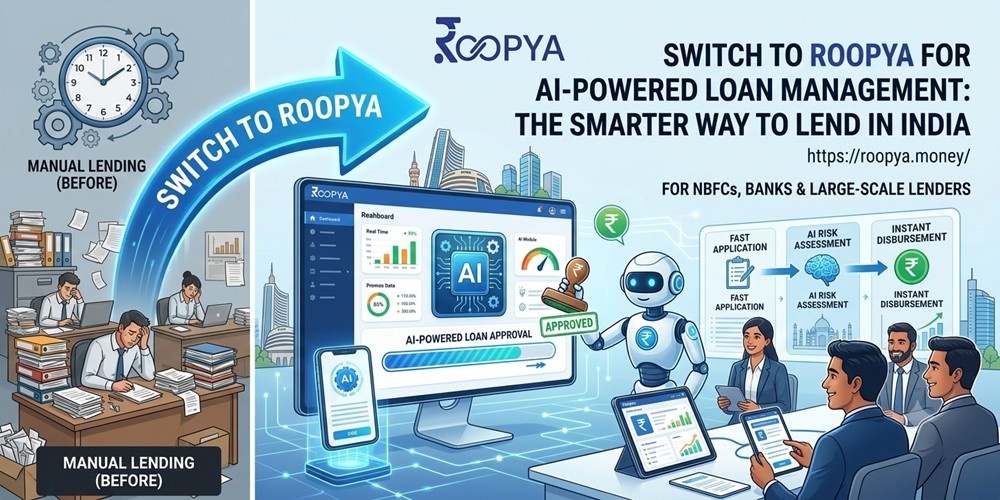
This page explains exactly why lenders are switching to Roopya, what they gain when they do, and how the migration process works — from decision to go-live in as little as one day.
1. The Problem with Legacy Loan Management Systems
The Indian lending market has evolved faster than the software that most lenders use to run it. NBFCs licensed five to ten years ago often built their operations on platforms that were state-of-the-art at the time — but were never designed for the pace and complexity of digital lending in 2026 and beyond.
Here are the most common failure points that lenders cite before switching to Roopya:
Slow, Rigid Workflows
Legacy loan management systems are typically built on rigid, hardcoded workflows. Every time a lender wants to launch a new product, change a credit policy, or adjust an approval threshold, they must raise a ticket with their software vendor and wait weeks or months for development work. In a market where product-market fit must be tested and iterated rapidly, this is a fatal constraint.
Poor or Absent AI Capabilities
Traditional loan management software relies almost entirely on manual processes or rules-based logic that was configured at the time of implementation. It does not learn from new data. It cannot detect document fraud patterns it has not seen before. It cannot adapt credit scoring models as macroeconomic conditions change. The result is a lending operation that becomes progressively less accurate and less competitive over time.
Integration Nightmares
Every modern lending operation requires dozens of integrations — credit bureaus, KYC providers, eSign platforms, payment gateways, accounting systems, GST portals, and more. Legacy systems were not designed with open API architectures. Each integration requires custom development, extensive testing, and ongoing maintenance. The cost and complexity of integrations alone drives many lenders to switch.
Compliance Risk
RBI regulations for NBFCs, MFIs, and banks are updated continuously. Legacy platforms often lag behind regulatory changes, leaving compliance teams to manage the gap manually — with spreadsheets, email trails, and manual audit logs. This is not only inefficient but creates genuine regulatory risk.
Escalating Cost of Ownership
Large upfront licensing fees, annual maintenance contracts, expensive customisation charges, and IT infrastructure costs make legacy loan management software extremely expensive over time. And yet, despite the cost, performance rarely improves — it degrades, as the software ages and the maintenance burden grows.
The pattern is clear: legacy loan management systems are not just inconvenient. They are actively damaging the competitiveness and profitability of the lenders who run on them. Switching to a modern, AI-powered platform like Roopya is not a luxury — it is a strategic imperative.
2. What Is Roopya’s AI-Powered Loan Management Platform?
Roopya is a unified, no-code lending infrastructure platform that covers the complete lending lifecycle — from loan origination and KYC through credit decisioning, disbursement, portfolio management, collections, and regulatory reporting. It is built specifically for the Indian financial services ecosystem, with native support for RBI compliance, Indian credit bureaus, Aadhaar-based KYC, and UPI-powered payments.
The defining characteristic of Roopya is that artificial intelligence is not an add-on feature or a premium tier — it is embedded at every stage of the platform. Every document that passes through Roopya is analysed by AI. Every credit decision is supported by machine learning models. Every collection strategy is optimised by behavioural AI. Every fraud signal is detected by pattern recognition algorithms that improve continuously.
Roopya is trusted by modern lenders including IndiaKaLoan, QuickFinShop, Recapita, Findoc, EazyCredit, and LonaSeva — institutions that chose to build on a forward-looking platform rather than be constrained by legacy infrastructure.
3. What You Get When You Switch to Roopya
3.1 AI-Powered Document Analysis — 99%+ Accuracy
One of the most time-consuming and error-prone aspects of loan management is document processing. Salary slips, bank statements, GST returns, ITR files, identity documents — processing these manually is slow, inconsistent, and prone to fraud. Roopya’s AI-powered document engine uses advanced OCR and NLP to extract, verify, and analyse every document in seconds, with accuracy exceeding 99%.
The system does not merely read documents — it understands them. It detects anomalies, flags fabricated bank statements, identifies income irregularities, and cross-checks data across multiple documents automatically. What used to take a team of underwriters hours is done in under a minute.
3.2 AI-Enhanced No-Code Business Rule Engine
Roopya’s Business Rule Engine (BRE) is the mechanism through which your credit policy comes alive. Unlike rule engines in legacy platforms that require developer intervention for every change, Roopya’s BRE is fully no-code — your credit and risk teams can configure, test, and deploy new decisioning rules in minutes, without a single line of code.
What makes Roopya’s BRE genuinely different is its AI layer. The engine learns from historical approval and rejection data, identifies patterns that human analysts might miss, and proactively suggests rule optimisations to improve portfolio performance. It adapts to market conditions automatically while keeping your team fully in control.
3.3 Intelligent Credit Decisioning in Milliseconds
Roopya’s AI credit scoring models go far beyond traditional bureau score-based decisioning. They analyse thousands of data points — alternative financial data, behavioural patterns, device and digital footprint signals, GST performance, bank account analytics, and real-time financial indicators — to produce accurate, personalised risk assessments.
The result is a credit decision delivered in milliseconds, not days. For your borrowers, this means instant loan offers and a dramatically better experience. For your business, it means higher conversion rates, more consistent risk management, and a portfolio that performs as your models predict.
3.4 End-to-End Loan Origination System
Switching to Roopya gives you access to a complete, AI-powered loan origination system — digital application forms, automated KYC (Aadhaar eKYC, PAN, Digilocker, VKYC), credit bureau integration with CIBIL, Experian, CRIF and Equifax, offer generation, eSign, and disbursement trigger — all in a single, unified platform. With 20+ pre-configured loan product journeys, you can launch personal loans, business loans, gold loans, microfinance products, and more without building anything from scratch.
3.5 Advanced Loan Portfolio Management
Once loans are disbursed, Roopya’s Loan Management System (LMS) takes over. It provides comprehensive portfolio visibility — repayment schedules, amortisation calculations, prepayment processing, EMI collection, penal interest computation, and loan restructuring — all in one place. Every portfolio metric is visible in real time, with customisable dashboards and automated reporting.
3.6 AI-Driven Collections Engine
Collections is where many lending businesses lose significant value. Roopya’s AI-driven collections engine analyses borrower behaviour, payment history, and external signals to predict which accounts are at risk of default before they actually default. It then optimises collection strategies — communication channel, timing, message content, agent assignment — for each borrower individually.
The result is a 60% improvement in collection effectiveness compared to generic, calendar-based reminder systems. Lenders on Roopya recover more, spend less on collections operations, and preserve borrower relationships more effectively.
3.7 Early Warning System for Proactive Risk Management
Roopya’s Early Warning System (EWS) uses predictive analytics and behavioural modelling to identify accounts that are beginning to show stress — even before the first missed payment. Risk managers receive automated alerts with recommended interventions, allowing them to act before a delinquency event rather than after.
This proactive risk management capability is a significant upgrade from the reactive, overdue-bucket-based monitoring that most legacy systems offer.
3.8 Natural Language Analytics and Reporting
Roopya’s AI-driven analytics platform allows your team to ask questions about your portfolio in plain English — and receive instant, detailed analysis. Instead of waiting for the MIS team to pull a report, a credit manager can type a question and receive a chart, table, or executive summary in seconds.
Regulatory reports, board presentations, RBI submissions, and investor updates — all can be generated automatically from Roopya’s reporting module, saving hours of manual effort every month.
3.9 300+ Pre-Integrated APIs — No Custom Development
Roopya eliminates the integration nightmare that plagues legacy lending platforms. The platform ships with 300+ pre-built integrations covering every API that a modern Indian lender needs — all major credit bureaus, KYC providers, eSign platforms (Aadhaar OTP, Digilocker), payment gateways (NACH, UPI, IMPS), accounting software, banking APIs, GST data, and more. There is no custom development required to go live with these integrations — they are ready out of the box.
3.10 Full RBI Compliance, Always Updated
Staying compliant with RBI regulations is a moving target. New guidelines, fair practice codes, data localisation requirements, and credit bureau reporting mandates are issued regularly. Roopya’s compliance team monitors all regulatory changes and pushes updates to the platform continuously — so your lending operation is always compliant without any action from your side. Built-in audit trails, digital consent management, and automated regulatory reporting are standard features, not extras.
4. The Roopya Advantage: By the Numbers
When lenders switch to Roopya, the impact is measurable and immediate. Here are the key performance improvements that Roopya’s customers consistently report:
- 10x Faster Processing: Roopya’s intelligent document processing reduces verification time from hours to seconds.
- 40% Better Credit Accuracy: ML-powered credit scoring delivers superior accuracy compared to traditional bureau-score-only methods.
- 80% Fraud Reduction: Built-in AI fraud modules detect suspicious patterns instantly across all applications.
- 60% Better Collections: The AI-driven collections engine optimises recovery strategies based on individual borrower behaviour.
- 40–60% Lower Processing Cost: Automation of manual workflows dramatically reduces cost per loan application and loan management.
- 95% Borrower Satisfaction: Roopya’s conversational AI handles borrower interactions with contextual understanding and near-perfect satisfaction scores.
- 1-Day Go-Live: The average time from signing up to processing live applications on Roopya is one business day.
5. Who Should Switch to Roopya?
Roopya is purpose-built for the Indian lending ecosystem and is the right choice for a wide range of financial institutions:
NBFCs Scaling Rapidly
Fast-growing NBFCs need a platform that can keep pace with their growth without requiring proportional increases in headcount or IT spend. Roopya’s cloud-native architecture scales automatically — handling ten applications a day or ten thousand with the same infrastructure and the same performance.
Banks Modernising Their Retail Lending Stack
Banks that are modernising their retail and SME lending operations need a platform that integrates with their existing core banking systems while delivering state-of-the-art digital origination and management capabilities. Roopya’s open API architecture makes this integration straightforward and fast.
Microfinance Institutions Expanding Digitally
MFIs face unique challenges — serving rural and semi-urban borrowers with limited digital literacy, managing group lending models, and operating across geographies with variable connectivity. Roopya’s platform supports MFI-specific workflows including JLG (Joint Liability Group) models, offline-capable agent apps, and Aadhaar-based KYC that works for Tier 3 and Tier 4 borrowers.
New NBFC Licencees Starting from Scratch
Newly licenced NBFCs are in an enviable position — they can build on a modern platform from day one rather than inheriting legacy debt. Roopya’s pay-as-you-use model means zero upfront capital expenditure, and the 1-day go-live means you can begin lending operations almost immediately after receiving your licence.
Fintech Lenders and Embedded Finance Providers
Fintechs building lending products within consumer apps, B2B platforms, or supply chain finance solutions need a lending engine they can embed via API — not a standalone portal that requires borrowers to leave their native experience. Roopya’s open API architecture and embedded finance capabilities make it the ideal backend for fintech lending products.
6. How the Switch to Roopya Works
One of the most common concerns lenders have about switching loan management platforms is the migration risk — downtime, data loss, workflow disruption, and team retraining. Roopya has addressed these concerns systematically:
- Step 1 – Discovery & Configuration (Day 1): A Roopya implementation specialist works with your team to understand your existing workflows, credit policy, product parameters, and integration requirements. Your Roopya environment is configured using the no-code setup interface — typically completed in a single day.
- Step 2 – Data Migration: Your existing loan portfolio data is migrated to Roopya’s platform using structured data templates. Roopya’s migration tools handle clean data imports with validation checks to ensure accuracy. Historical data — borrower profiles, loan records, repayment histories — is preserved completely.
- Step 3 – Integration Activation: Required third-party integrations (bureaus, KYC, payments) are activated from Roopya’s pre-built integration library — no development work required. Custom integrations with legacy core banking systems are supported through Roopya’s open API layer.
- Step 4 – Parallel Running & UAT: For lenders who prefer a cautious transition, Roopya supports a parallel-running period where the new platform processes incoming applications while legacy systems continue managing the existing portfolio. User acceptance testing (UAT) is completed during this period.
- Step 5 – Full Go-Live: Once the team is comfortable and testing is complete, the full switch is made. Roopya provides dedicated support during the go-live window to ensure a smooth transition.
- Step 6 – Ongoing Optimisation: Post go-live, Roopya’s customer success team works with you to optimise credit policies, BRE configurations, and collection strategies based on portfolio performance data.
The entire process — from initial conversation to processing live applications — takes as little as one business day for lenders with straightforward requirements, and rarely more than two weeks even for complex, multi-product operations.
7. Roopya vs. Your Current Platform: A Comparison
- Speed to Market: Legacy platforms require months of implementation. Roopya goes live in 1 day.
- AI Capabilities: Legacy platforms have no AI or basic rules. Roopya has AI at every stage — document analysis, credit scoring, fraud detection, collections, and analytics.
- No-Code Configuration: Legacy platforms require developers for every policy change. Roopya is fully no-code for business users.
- Integration Ecosystem: Legacy platforms require custom development per integration. Roopya has 300+ pre-built integrations ready to activate.
- Pricing Model: Legacy platforms charge large upfront licence fees. Roopya uses pay-as-you-use with zero upfront cost.
- Compliance Updates: Legacy platforms lag behind RBI changes. Roopya is continuously updated for full regulatory compliance.
- Scalability: Legacy platforms require infrastructure provisioning. Roopya scales automatically in the cloud.
- Fraud Detection: Legacy platforms have minimal fraud capability. Roopya has AI-powered fraud detection across all application touchpoints.
- Collections Intelligence: Legacy platforms use calendar-based reminders. Roopya uses AI-driven behavioural optimisation for every borrower.
8. Real-World Impact: What Switching Lenders Experience
The best evidence for why lenders should switch to Roopya comes from the experiences of those who already have. Across Roopya’s customer base — which includes fast-growing digital NBFCs, specialist MFIs, and embedded finance providers — the consistent themes are speed, cost reduction, and competitive advantage.
Lenders report that their underwriting teams — previously occupied with manual document review and data entry — are now focused on portfolio strategy and borrower relationships, because the routine work is handled entirely by Roopya’s AI. Credit managers describe the shift from reactive management of overdue accounts to proactive risk management as transformative for portfolio quality.
Compliance officers note that the continuous regulatory updates built into Roopya’s platform have eliminated the compliance backlog that used to consume days of work every quarter. And technology teams report that the open API architecture and no-code configuration have reduced their dependency on external vendors for operational changes — restoring agility to the business.
Perhaps most significantly, lenders consistently report that their borrowers notice the difference. Faster decisions, clearer communication, smoother digital journeys, and more personalised offers translate directly into higher customer satisfaction scores and better word-of-mouth referral rates.
9. The Cost of Not Switching
There is a common cognitive trap that keeps lenders on underperforming platforms: the sunk cost fallacy. Having invested significantly in a legacy system, it feels costly to switch. But the true cost calculation must account for what the legacy system is costing you every day you stay on it.
Every application that takes hours instead of seconds to process is a borrower who may have already accepted an offer from a faster competitor. Every manual document review is a salary cost that could be eliminated. Every compliance gap is a regulatory risk that grows quietly. Every missed fraud signal is a default that eats into portfolio returns. Every day without AI-powered collection intelligence is revenue left on the table.
When lenders calculate the total cost of staying on a legacy platform — including opportunity costs, operational inefficiency, compliance risk, and the compounding competitive disadvantage — the economics of switching to Roopya become overwhelmingly clear. The question is not whether you can afford to switch. It is whether you can afford not to.
10. Start Your Switch to Roopya Today
Switching to Roopya begins with a free, no-obligation demo. In 30 minutes, you will see exactly how Roopya’s AI-powered platform works, how it compares to your current system, and how quickly your team can go live. There are no lengthy sales cycles, no complex procurement processes, and no upfront costs.
Roopya’s team of lending technology specialists will guide your entire migration — from initial configuration through data migration, integration activation, and go-live. For most lenders, the switch is completed in a single business day.
Join IndiaKaLoan, QuickFinShop, Recapita, Findoc, EazyCredit, LonaSeva, and the growing community of modern Indian lenders who have already made the switch. Go live in a day. Lend smarter, every day after that.

