10 Types of Loan Management Software (and Which One You Actually Need)

The lending industry has changed dramatically over the last few years. Traditional loan processing methods that relied on paperwork, spreadsheets, and manual approvals are rapidly being replaced by intelligent digital lending platforms. Today, lenders need faster approvals, automated underwriting, real-time repayment tracking, compliance management, AI-driven analytics, and seamless borrower experiences.
This is where modern Loan Management Software (LMS) becomes essential.
Start Free Trial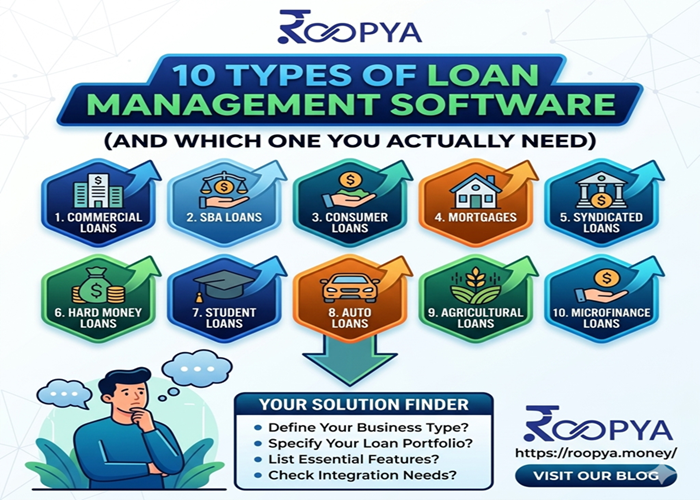
Whether you are an NBFC, fintech startup, bank, microfinance institution, cooperative society, gold loan company, or digital lender, choosing the right software platform can directly impact your operational efficiency, borrower satisfaction, collections performance, and profitability.
Modern lending software platforms now combine:
- Loan Origination Systems (LOS)
- Loan Management Systems (LMS)
- AI Credit Decisioning
- Collections Automation
- Digital KYC
- Payment Integrations
- Analytics & Reporting
- Compliance Management
- Cloud Infrastructure
- API Banking
According to Roopya Money, modern lenders increasingly prefer no-code, AI-first, cloud-native lending systems that automate the complete loan lifecycle — from onboarding to collections.
In this guide, we will explain the 10 major types of Loan Management Software, their use cases, advantages, disadvantages, and help you determine which solution your lending business actually needs.
What Is Loan Management Software?
Loan Management Software is a digital platform that helps lenders automate and manage the entire lending lifecycle.
A complete LMS platform typically handles:
- Borrower onboarding
- Loan applications
- Credit assessment
- Underwriting
- Document verification
- Disbursement
- EMI management
- Collections
- Delinquency tracking
- Reporting
- Regulatory compliance
Modern systems also include AI-powered risk analysis, automation workflows, OCR-based document extraction, payment gateway integrations, and analytics dashboards.
Why Loan Management Software Is Important
Without automation, lenders face:
- Slow approvals
- Manual errors
- Higher operational costs
- Poor collections tracking
- Compliance risks
- Fraud exposure
- Customer dissatisfaction
A robust LMS helps lenders:
- Approve loans faster
- Reduce defaults
- Improve repayment collection
- Scale operations efficiently
- Ensure RBI compliance
- Enhance borrower experience
Many Indian NBFCs are now prioritizing AI-driven lending platforms with no-code configuration and real-time analytics.
1. Traditional Loan Management Software
Best For:
- Small finance companies
- Offline lenders
- Cooperative societies
Traditional LMS platforms are usually installed on local servers and rely heavily on manual processes. These systems were designed primarily for basic loan bookkeeping and repayment tracking.
Features
- Loan ledger management
- EMI calculations
- Basic customer database
- Manual approval workflows
- Limited reporting
Limitations
- No AI automation
- Limited integrations
- Slow scalability
- High infrastructure maintenance
- Poor digital borrower experience
When to Choose
Choose traditional LMS only if your organization operates entirely offline and has minimal digital lending requirements.
2. Cloud-Based Loan Management Software
Best For:
- NBFCs
- Fintech startups
- Digital lenders
- Modern banks
Cloud-based LMS platforms are hosted online and allow lenders to access operations from anywhere.
According to Roopya LMS Platform, cloud-native infrastructure enables automatic scaling, enterprise-grade security, and high uptime reliability.
Features
- Web-based access
- Real-time loan tracking
- Multi-user management
- Automatic updates
- API integrations
- Centralized dashboards
Advantages
- Lower infrastructure costs
- Faster deployment
- Easy scalability
- Remote accessibility
- Better data security
Ideal For
Lenders planning rapid growth or digital transformation.
3. AI-Powered Loan Management Software
Best For:
- Fintech companies
- Digital lenders
- High-volume NBFCs
AI-powered LMS platforms use machine learning and predictive analytics to automate lending decisions.
Features
- AI credit scoring
- Fraud detection
- Predictive risk analysis
- Automated underwriting
- Smart collections prioritization
Roopya’s AI-driven lending system includes predictive analytics, behavioral scoring, and automated decision-making capabilities.
Benefits
- Faster approvals
- Reduced NPAs
- Better credit assessment
- Lower operational costs
- Improved collections
Ideal For
Fast-growing lenders managing large borrower volumes.
4. Loan Origination Software (LOS)
Best For:
- Digital onboarding
- Loan processing automation
- Fintech applications
A Loan Origination System focuses on the front-end lending journey before loan disbursement.
Features
- Digital application forms
- KYC verification
- Bureau integrations
- Automated underwriting
- Workflow approvals
- Document OCR
Modern LOS platforms integrate with CIBIL, Experian, Equifax, and CRIF for real-time borrower verification.
Advantages
- Faster borrower onboarding
- Reduced paperwork
- Improved approval turnaround time
- Better compliance
Ideal For
Lenders seeking rapid digital onboarding.
5. End-to-End Lending Platforms
Best For:
- NBFCs
- Banks
- Large fintech ecosystems
End-to-end lending software combines LOS, LMS, collections, analytics, and compliance in a single platform.
Features
- Origination
- Disbursement
- Repayment tracking
- Collections
- Analytics
- Customer portals
- AI decisioning
Roopya positions itself as a full lending infrastructure platform covering the complete lifecycle from application to collections closure.
Advantages
- Unified borrower data
- No multiple software vendors
- Easier reporting
- Better operational efficiency
Ideal For
Organizations seeking a complete digital lending ecosystem.
6. Microfinance Loan Management Software
Best For:
- MFIs
- SHG lenders
- Rural finance institutions
Microfinance LMS platforms are designed specifically for small-ticket lending operations.
Features
- Group lending management
- Daily EMI tracking
- Field officer apps
- Offline mobile sync
- Cash collection management
Industry discussions highlight that daily repayment logic and field collection tools are essential for microfinance operations.
Advantages
- Supports rural operations
- Handles high borrower volumes
- Mobile-friendly collections
- Multi-branch support
Ideal For
Microfinance and rural lending institutions.
7. Gold Loan Management Software
Best For:
- Gold loan NBFCs
- Jewel-backed lenders
Gold loan software specializes in collateral-based lending operations.
Features
- Gold purity tracking
- Collateral valuation
- Auction management
- Loan-to-value calculations
- Security audit trails
Advantages
- Better collateral security
- Faster disbursement
- Reduced valuation errors
Ideal For
Gold finance companies.
8. Mortgage & Home Loan Management Software
Best For:
- Housing finance companies
- Mortgage lenders
- LAP providers
Mortgage LMS platforms manage long-term secured lending.
Features
- Property documentation
- Legal verification
- Multi-stage approvals
- Construction finance workflows
- SARFAESI compliance
Modern platforms support milestone-based disbursements and secured asset recovery workflows.
Advantages
- Better compliance
- Document-heavy workflow automation
- Easier property tracking
Ideal For
Housing finance and LAP lenders.
9. Collections & Recovery Software
Best For:
- High delinquency portfolios
- Collection agencies
- NBFC recovery teams
Collections platforms focus specifically on repayment recovery and delinquency management.
Features
- Automated reminders
- WhatsApp/SMS collections
- AI default prediction
- Agent tracking
- Legal workflow management
Roopya’s AI-powered collections engine includes automated communications, GPS-enabled field tracking, and predictive default scoring.
Advantages
- Improved recovery rates
- Lower collection costs
- Better borrower engagement
Ideal For
Lenders managing large repayment portfolios.
10. No-Code Loan Management Software
Best For:
- Fast-scaling lenders
- Non-technical teams
- Agile fintech companies
No-code LMS platforms allow business users to configure loan products, rules, and workflows without developers.
Features
- Drag-and-drop workflows
- Product configuration
- Rule engines
- Dynamic approval flows
- Automated reporting
Industry experts emphasize that true no-code systems allow business teams to make operational changes without IT dependency.
Advantages
- Faster implementation
- Lower IT costs
- Rapid product launches
- Operational flexibility
Ideal For
Modern fintechs and scalable NBFCs.
Which Loan Management Software Do You Actually Need?
Choosing the right LMS depends on:
| Business Type | Recommended Software |
|---|---|
| Small Offline Lender | Traditional LMS |
| Fintech Startup | Cloud-Based AI LMS |
| NBFC | End-to-End Lending Platform |
| MFI | Microfinance LMS |
| Gold Loan Company | Gold Loan Software |
| Housing Finance Company | Mortgage LMS |
| Large Digital Lender | AI-Powered LMS |
| Rapidly Scaling Fintech | No-Code LMS |
Key Features Every Modern LMS Should Include
Digital Borrower Onboarding
Modern lenders require:
- eKYC
- Aadhaar verification
- PAN verification
- OCR document capture
AI Credit Decisioning
AI helps automate:
- Credit scoring
- Fraud checks
- Risk prediction
Automated Collections
Automated reminders improve repayment efficiency.
Real-Time Analytics
Live dashboards provide portfolio visibility.
Compliance Management
RBI reporting and audit trails are critical for Indian lenders.
API Integrations
Integrations with:
- Credit bureaus
- Payment gateways
- Banking APIs
- Accounting software
Benefits of Modern Loan Management Software
Faster Loan Approvals
Automation significantly reduces processing time.
Lower Operational Costs
Less manual work means lower staffing costs.
Better Customer Experience
Digital onboarding improves borrower satisfaction.
Improved Collections
AI-powered reminders reduce delinquency.
Better Risk Management
Real-time analytics identify risky borrowers early.
Common Mistakes When Choosing LMS Software
Choosing Based Only on Price
Cheap systems often lack scalability.
Ignoring Compliance
Non-compliant systems can create regulatory risks.
Selecting Non-Scalable Platforms
Your LMS should support future growth.
Overlooking Integrations
Modern lending requires connected ecosystems.
Ignoring Collections Automation
Collections directly impact profitability.
Why Indian NBFCs Are Moving Toward AI Lending Platforms
The Indian digital lending ecosystem is rapidly evolving.
Modern lenders now prioritize:
- Cloud infrastructure
- AI automation
- Co-lending support
- Real-time analytics
- No-code configuration
Industry discussions increasingly focus on AI-driven collections, co-lending workflows, and configurable lending infrastructure.
Why Roopya Is Emerging as a Modern Lending Platform
Roopya Money Lending Platform offers:
- AI-first architecture
- Cloud-native deployment
- No-code workflow configuration
- LOS + LMS + Collections
- RBI-ready compliance tools
- API integrations
- Real-time analytics
- Digital borrower onboarding
Their platform supports:
- NBFCs
- Banks
- MFIs
- Fintech startups
- Co-lending operations
- Digital consumer lending
Roopya also emphasizes rapid implementation with go-live timelines as short as 5–7 days.
Final Thoughts
The future of lending belongs to digital, AI-powered, cloud-native platforms.
Whether you are a startup fintech, established NBFC, microfinance institution, or digital lender, the right Loan Management Software can transform your business operations.
The best LMS platform should help you:
- Automate lending workflows
- Improve borrower experience
- Reduce operational costs
- Minimize defaults
- Scale faster
- Stay compliant
In 2026, lenders are no longer choosing software just for bookkeeping — they are choosing technology platforms that directly influence growth, risk management, and customer acquisition.
If your organization plans to scale digitally, investing in a modern end-to-end lending platform like Roopya LMS Software can provide the infrastructure needed to compete in today’s rapidly evolving lending ecosystem.

